
The desk hutch had its moment. It held your printer, your binder clips, and about four years of paperwork you were definitely going to organize someday. But if you've ever tried to fit a modern monitor under one, or sat there staring at a wall of particleboard six inches from your face, you know the hutch has outlived its usefulness.
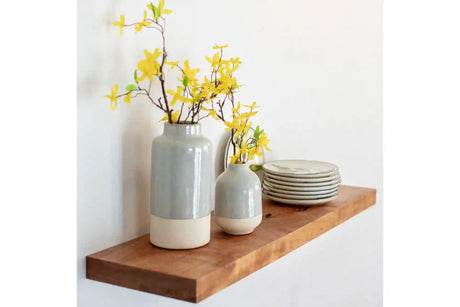
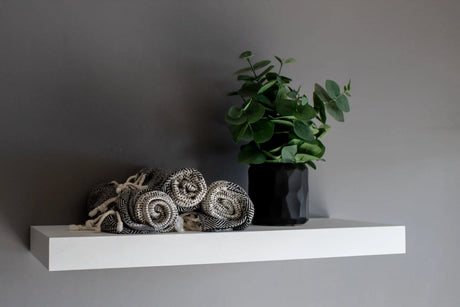
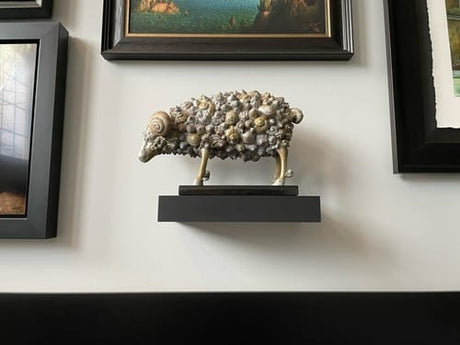
Office floating shelves above the desk do everything a hutch does, without the claustrophobia. They open up the wall, give you storage you can actually see, and make a home office look like a room you chose to work in rather than a room you got stuck in. I wrote a full breakdown in Ditch the Desk Hutch, but this post focuses specifically on layout ideas, sizing, and height for shelves directly above a desk.
How High to Mount Shelves Above a Desk
This is the question everyone asks first, and the answer is simpler than most people make it.

The bottom shelf should sit 22" to 24" above the desk surface. That's high enough to clear a monitor (most are 15" to 18" tall) with room to spare, and low enough that you can reach the shelf without standing up. If you're using a monitor arm that lifts the screen higher than standard, add a couple of inches.
For a second shelf above the first, space them 12" to 14" apart. That's enough room for books standing upright, a small plant, or a desk lamp without the shelves feeling cramped. My spacing guide covers the math in more detail if you're stacking more than two.
One practical tip: sit at your desk before you drill. Reach up and touch the wall at the highest comfortable point. That's your upper limit. Anything above that becomes dead storage you never touch, and there's no point wasting good shelf space where you can't reach it.
Layout Ideas That Actually Work

Single shelf, full desk width. The simplest setup and often the best. One shelf running the full width of your desk (or slightly wider) creates a clean horizontal line that anchors the workspace. Use it for the three or four things you reach for every day and leave the rest in drawers.
Two stacked shelves, centered. The most common layout I build. Bottom shelf for active use (reference books, a small speaker, your coffee mug's permanent home). Top shelf for display (a plant, a photo, something that makes the wall feel finished). Same width, same depth, evenly spaced.
Asymmetric pair. One longer shelf on top, one shorter shelf below, offset to one side. This works well if your desk is pushed against a wall with a window on one side, or if you want to leave room for a pinboard or framed art next to the shelves. It looks more intentional than a symmetric stack, and it's a good way to fill a wall that's wider than your desk.
L-shaped corner desk setup. If your desk wraps a corner, run shelves along both walls above it. Keep the shelf lengths proportional to the desk sections below them. This is where longer shelves in the 48" to 60" range come in, depending on how wide each wall section is.
Floor-to-ceiling bookshelf wall. For the home office that doubles as a library. Four to six shelves stacked from desk height to near the ceiling, all the same width. This is a commitment, but it looks incredible and holds a serious book collection. You'll want heavy duty shelves for this since loaded bookshelves get heavy fast, and the Hovr bracket handles 150 lbs per stud without sag.
Sizing: Width and Depth
Width: Match the desk or go slightly wider. A shelf narrower than the desk looks like it belongs to a different piece of furniture. If your desk is 48" wide, a 48" or 54" shelf looks proportional.

Depth: 10" is the sweet spot for above-desk shelves. Deep enough for books, binders, and a small speaker. Shallow enough that it doesn't feel like a second desk hovering over you. Go 12" only if you're storing large items (monitors, printers) or using the shelves as primary storage rather than display.
8" works if the shelves are purely decorative (frames, plants, a couple of small objects), but most people underestimate how much stuff ends up on office shelves. I'd default to 10" unless you have a specific reason to go narrower. Full breakdown in the depth guide.
Wood Species for an Office
The office is one of the rooms where wood choice really affects the mood. You're sitting in this room for hours, so the finish and grain are in your peripheral vision all day.
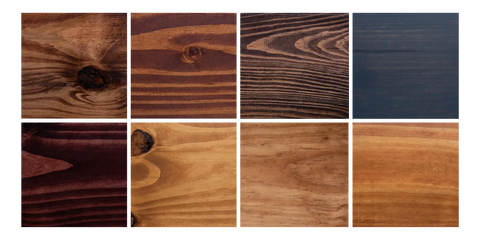
Walnut is the most popular species I build for home offices. The dark grain feels warm and grounded, and it photographs well for video calls (not a small consideration anymore). It pairs naturally with leather chairs, dark desks, and warm lighting.
White oak is lighter and more neutral. It works well in modern or Scandinavian-style offices with light walls and clean lines. The grain is visible but not dramatic.
Maple is the lightest option. Pale, clean, almost blonde. If you want the shelves to fade into the wall rather than stand out, maple does that well.
Not sure which species works in your space? Order samples and hold them up against your wall in the room's actual lighting. Photos don't capture grain the way your eyes do.
Add Task Lighting Without a Desk Lamp
An LED strip routed into the wood on the underside of the bottom shelf puts clean, even light across your desk surface. No desk lamp, no clamp light, no cord draped across your workspace. The LED channel is routed directly into the shelf and the cord exits through a hole in the back, so the install is invisible.
It's $50 per shelf, and it's one of those upgrades that feels small until you see it in person. Especially useful if your desk is in a room without great overhead lighting.
Why Every Shelf Is Custom
Every shelf I build is custom sized to your wall dimensions. You're not stuck choosing between 24" and 36" from a dropdown menu and hoping one of them looks right above your desk. Measure the wall, pick the species, and I build it to fit. Widths from 12" to 72", depths from 6" to 12".
If your setup is unusual (angled ceiling, window in the way, awkward nook), send me the dimensions and I'll tell you what works. This is what I do every day, and I've built shelves for just about every weird wall configuration you can imagine.
Wall-Mounted Bookshelves for the Serious Reader
If your office doubles as your reading room, a stack of wall-mounted bookshelves turns the space into something between a home office and a personal library. Go 10" to 11" deep for standard hardcovers, stack four to five shelves from desk height up, and suddenly you've got room for a few hundred books without a single bookcase on the floor.
The weight matters here. A full shelf of books can hit 60 to 80 lbs on a 36" shelf. Every shelf I build ships with the Hovr bracket, which handles that comfortably. No sag, no drama, no middle-of-the-night shelf collapse.
A productive home office doesn't need much: a good desk, a good chair, and shelves that actually work. Browse the office floating shelves collection to see all the species and sizes, or reach out if you need help figuring out the right layout for your wall.