
You bought solid wood floating shelves. Or you're about to. Either way, you're now standing in front of a wall with a tape measure and a vague plan that amounts to "put them up and see how it looks."
That works sometimes. It also produces shelves that sit empty for six months because you never figured out what they were actually for. The best shelf setups start with a use case, not a wall. Figure out what the shelf needs to do and the sizing, placement, and species all follow from there.
Here are twelve setups that go beyond "hold a candle and a succulent." Every one uses the Hovr bracket at 150 lbs per stud, because most of these ideas put real weight on the shelf and cheap hardware doesn't survive that.
1. The Art and Photo Ledge
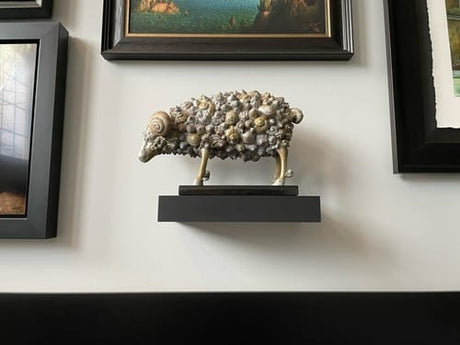
Hanging art directly on the wall means nail holes, a level, measuring twice, and the acceptance that you're never rearranging anything. A shelf gives you a surface to lean frames against the wall and swap them out whenever you want. New print? Just set it on the shelf. Bored of the arrangement? Move everything in thirty seconds.

Go 6" to 8" deep and as long as the wall allows. A single shelf above the couch at 48" to 60" long, mounted 8" to 10" above the cushions, holds three to five frames comfortably. Layer them front to back and mix sizes. Leave a gap or two for a small plant or a candle so it doesn't look like a shelf at a frame store.
For a living room display wall with multiple shelves stacked vertically, the key is varying frame heights across rows so each shelf feels like its own composition rather than a grid.
2. The Media Center Replacement
The bulky entertainment center had its run. It held your cable box, your DVD collection, and about nine remotes. Now the TV's on the wall and that six-foot piece of furniture is holding a soundbar and collecting dust behind it.
Two or three shelves below or flanking a wall-mounted TV replace the whole unit. One shelf for the soundbar and streaming devices. One for books or decor. One lower shelf for controllers, headphones, or a turntable if you're that person. Go 10" to 12" deep so the equipment has room, and longer shelves at 48" to 60" match the width of most TVs without looking undersized.

Walnut is the natural pick here. The dark grain gives the wall weight and the setup reads as furniture, not just shelves bolted to drywall.
3. The Nightstand Replacement
This one is simple and it works every time. A single shelf at mattress height, 24" to 36" long, 8" deep. Phone, book, lamp. The floor underneath is open, vacuuming happens, and you never have to wrestle a nightstand through a doorway during a furniture rearrangement again.
If one shelf isn't enough, stack a second one 12" above the first for a book or two and a small plant. But honestly, the point is to replace the nightstand entirely with something that forces you to keep the bedside minimal. Clutter expands to fill available surface. Less surface, less clutter.
4. The Corner Stack
Corners are dead space in most rooms. Too narrow for furniture, too awkward for a single shelf, so they sit empty and collect cobwebs. A corner setup with two shelves butted together (one on each wall) turns that dead zone into usable display or storage.

The Hovr bracket slides on the hardware, so you can push each shelf tight into the corner without a gap. No mitering required. Just two shelves meeting flush. Stack three or four pairs vertically and you've got a corner bookshelf that takes up zero floor space.
Go 24" to 36" per side depending on the wall length, 8" deep for display, 10" for books or heavier objects. The staggered look (shelves at alternating heights rather than matching on both walls) is more interesting than a perfect grid, but either works.
5. The Hallway Display
Hallways are the most underused walls in the house. They're long, they're narrow, and most people hang one photo and forget the rest exists. A set of hallway shelves running the length of the hall turns dead wall space into a gallery.
Go 6" deep so the shelves don't eat into the walking path. Mount at eye level (57" to 60" from the floor) or slightly above. A few frames, a small plant every three or four feet, and suddenly the hallway feels like part of the house instead of just the part between rooms.
For entryway and hallway setups with hooks, the entryway shelf guide covers sizing by household type.
6. The Bar Shelf
Bar floating shelves above a bar cart, a coffee station, or a wet bar hold bottles, glassware, and the accessories that make the setup feel intentional instead of temporary.
Go 10" to 12" deep (bottles need the depth) and space shelves 14" to 16" apart vertically so taller bottles clear the shelf above. Two shelves is usually enough: one for bottles, one for glasses. Three if you've got the wall height and the collection to fill it.

Weight matters here. A row of full liquor bottles gets heavy fast. That's where solid hardwood on the Hovr bracket earns its keep over the hollow-core shelves that start sagging after a few months of holding a bourbon collection.
7. The Pantry Organizer
Open pantry shelving replaces the deep wire shelves where cans go to die in the back corner. Floating shelves in a pantry keep everything visible and accessible. You can see every item at a glance instead of excavating behind a wall of forgotten soup cans.
Go 10" to 12" deep and space shelves 12" to 14" apart for standard pantry items. If you're storing taller items (cereal boxes, oil bottles, vinegar), give those shelves 16". Start the bottom shelf at 36" from the floor if there's counter space below, or lower if the pantry is a dedicated closet.
Maple is the go-to for pantries. Light, clean, and the tight grain doesn't compete with the visual noise of labels and packaging that's already happening on every shelf.
8. The Alcove or Niche Fit
That weird recessed area beside the fireplace, the niche under the stairs, the gap between two walls that's too narrow for furniture but too wide to ignore. Shelves cut to fit the exact space turn architectural leftovers into built-in storage that looks like it was always part of the plan.
Measure both the front and back of the opening, because nothing is square. Order 1/8" shorter than the shortest measurement. That leaves 1/16" on each side, which is enough to slide the shelf in without forcing it and tight enough that the gap is invisible.
9. The Home Office Stack
Three shelves above or beside a desk. Reference books, notebooks, project binders, and the personal photos that keep the workspace from feeling like a cubicle. Go 10" deep so binders and larger books fit without overhanging, 36" to 48" wide, stacked 12" to 14" apart.

Cherry in an office is an underrated pick. The warm tone reads as professional without the heaviness of walnut, and the patina develops over time into something richer than what you started with. It's the long game choice.
10. The Floor-to-Ceiling Library
Four to six shelves from 12" off the floor to 8" below the ceiling. That's a home library without the furniture. Every book you own, on the wall, visible from across the room.
Go 8" deep for standard books, 10" if you've got oversized hardcovers. Space shelves 12" to 14" apart. For help choosing the right depth, the depth guide covers the full breakdown by book size and use case.
This is where handmade floating shelves in solid hardwood separate themselves from the flat-pack alternatives. A full wall of books is a serious load across five or six shelves. Hollow core construction doesn't survive that. Solid wood on Hovr brackets handles it without a second thought.
11. The Laundry Room Upgrade
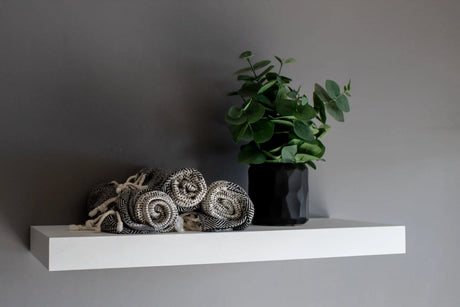
White shelves above the washer and dryer. Glass jars for pods. A basket for dryer balls. Maybe a plant that survives on neglect and dryer exhaust. Nobody plans to style their laundry room, but once you see one that looks nice, yours suddenly looks like a utility closet.
Go 36" to 48" long (match the washer/dryer pair), 8" to 10" deep, two shelves spaced 14" to 16" apart. Detergent bottles are tall. Give them room.
For the full breakdown on sizing, spacing, and replacing wire shelves, the laundry room shelving guide goes deeper.
12. The Dining Room Accent
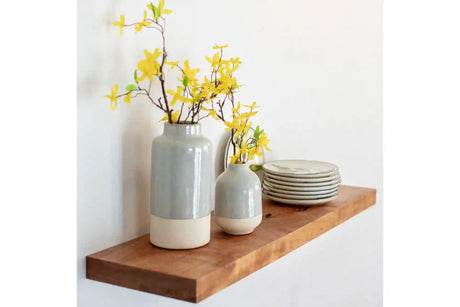
A single shelf on the wall opposite the table, or flanking a window, holding a few pieces that set the tone for the room. A couple of ceramics, a framed print, a bottle of wine that's too nice to drink but looks great on display. The shelf does the work of a sideboard without eating four feet of floor space.

Go 36" to 48" long, 8" deep. One shelf is usually enough in a dining room. The goal is accent, not storage.
Why Solid Wood Matters for All of This
Half of these setups put real weight on the shelf. Books, bottles, dishes, equipment. The other half put the shelf at eye level in a room where people actually look at it. Both scenarios punish cheap materials.
Hollow core shelves flex under load. The flex gets worse over time. The veneer chips at the edges. The bracket loosens in drywall anchors because there's nothing solid for it to grip inside the shelf. A year later you've got a shelf that leans forward, a crack behind the bracket, and a decision about whether to fix it or take the whole thing down.
Solid hardwood doesn't do any of that. The Hovr bracket engages the full depth of the wood, the load distributes evenly, and the shelf stays where you put it. That's not marketing. That's material science.
Start With the Use Case, Not the Wall
Figure out what the shelf needs to do. Then pick the species, the depth, the length, and the placement. Every shelf in the wood floating shelves collection is built to order in your exact dimensions, ships with the Hovr bracket at 300 lbs capacity, and comes with a lifetime guarantee against warping and cracking. Measure the wall, pick the setup, and I'll build the shelf to fit it.