
Bathrooms don't get a lot of wall space to work with. Between the mirror, the towel bar, the toilet, and the vanity, there isn't much room left. But the space that is left? Floating shelves own it.
I build more bathroom floating shelves than you'd expect for a room this small. The reason is simple: bathrooms have a lot of stuff and not a lot of places to put it. A shelf or two in the right spot solves most of that without a renovation.
Here are 15 ideas that actually work, based on what I've built and what customers keep coming back for.
1. Above the Toilet

This is the most popular bathroom shelf placement by a wide margin. The wall above the toilet is almost always empty, and it's the perfect height for a shelf holding towels, candles, a small plant, or whatever keeps the room from feeling sterile.
Go 8" deep and 24" to 30" wide. That keeps the shelf close to the wall and well clear of anyone standing up. One shelf works. Two stacked 12" apart doubles the storage without crowding the space.
2. Above the Sink (Below the Mirror)
If your mirror doesn't go all the way to the backsplash, there's usually a 6" to 10" gap between the mirror and the sink. A narrow shelf in that gap puts toothpaste, hand soap, and a small plant right where you need them, and gets them off the counter.
This one needs to be shallow. 6" deep max. You don't want to bump it while leaning into the mirror.
3. Next to the Mirror
If there's no room below the mirror, check the wall on either side. A single vertical stack of two or three small shelves (12" to 18" wide, 6" to 8" deep) flanking the mirror creates a clean, symmetrical look and holds daily essentials without competing with the mirror for visual attention.
4. Towel Storage

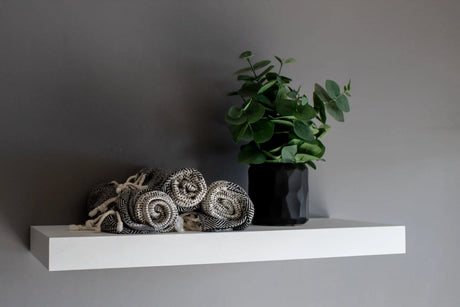
A pair of shelves dedicated to rolled or folded towels is one of the cleanest storage solutions in any bathroom. Stack two shelves 12" to 14" apart, 24" to 36" wide, 8" to 10" deep. Roll the towels and line them up. It looks like a spa, and it keeps towels accessible without a bulky linen cabinet.
For an extra touch, mount hooks or a small towel bar on the underside of the bottom shelf. Solid hardwood handles it without the material crumbling around the screw hole.
5. Under the Sink (Open Vanity)
If you have a wall-mounted or pedestal sink with open space below, a floating shelf underneath turns that dead space into storage. Baskets, extra toilet paper, cleaning supplies. It's functional, it's out of the way, and it beats staring at exposed plumbing.
6. Faux Built-In Look
Run a shelf wall-to-wall between two surfaces (between the vanity and the wall, between two walls in an alcove, or across a nook) and it reads like built-in shelving without the construction. The shelf spans the full width, the ends sit flush, and the whole thing looks permanent.
Measure front and back (bathroom walls are rarely perfectly square) and order the shelf 1/8" shorter than the span for a clean fit.
7. Corner Shelf

Bathrooms almost always have at least one dead corner. Corner shelves put that space to work. Two shelves at the same height on adjacent walls, butted together in an L formation, hold more than you'd expect and fill a spot nothing else can reach.
8. Above the Bathtub
If you have a standalone tub or a tub against a wall with empty space above, a single shelf at comfortable reaching height gives you a spot for candles, a book, bath salts, and a speaker. 8" deep, 24" to 36" wide.
Keep in mind: this shelf will see steam and occasional splashing. A polyurethane finish handles that fine, but you'll want to wipe it down regularly. White oak and maple both handle bathroom humidity well.
9. Stacked Display Wall

Three or four shelves stacked on a single wall, evenly spaced, creates a display feature in the bathroom. Mix towels with plants, candles, and small decorative objects. Stagger the items (tall on one end, short on the other, alternate sides) so it doesn't look like a grocery store shelf.
This works best on the wall opposite the vanity, where you see it every time you look up from the sink.
10. Nightlight Shelf
A shelf with LED lighting routed into the underside puts a soft glow across the wall below. In a bathroom, that's an ambient nightlight that replaces the blinding overhead fixture for middle-of-the-night trips. I route the LED channel directly into the wood for $50 per shelf. No adhesive strips, no visible hardware.
11. Painted to Match the Wall

Painted white floating shelves on a white wall disappear into the background. The shelf becomes invisible and the objects on it float. It's a minimalist look that works especially well in small bathrooms where you don't want the shelf itself competing for visual space.
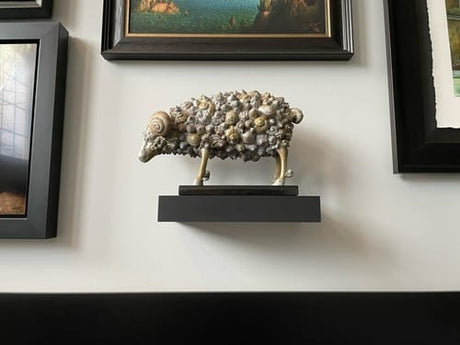
Painted black on a dark wall does the same thing with more drama. Either way, the shelf blends in and the contents take center stage.
12. Contrasting Wood Against Tile
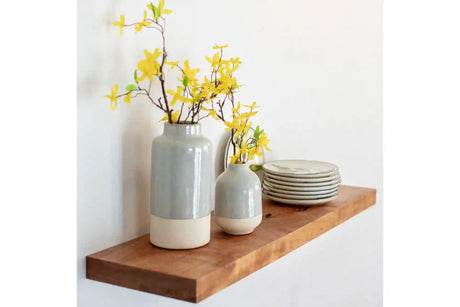
This is the opposite approach: use the shelf's natural wood grain as a design element against your tile or painted walls. Walnut against white subway tile is one of the best combinations I see in customer install photos. The dark grain pops against the light tile and adds warmth to a room that can otherwise feel cold and clinical.
13. Narrow Ledge for Small Items
A 6" deep shelf running 24" to 30" wide is all you need for a razor, a small succulent, a watch, and a ring dish. It's not storage; it's a landing strip for the things you take off and put on every day. Mount it at eye level near the door and it becomes part of your routine.
14. Adjacent to the Shower
The wall right outside the shower door or curtain is prime shelf territory. A single shelf at waist height holds a fresh towel, a robe, or a folded washcloth, right where you need it the second you step out. 8" deep, 18" to 24" wide. Simple, functional, solves the "where did I put the towel" problem permanently.
15. Connected to the Laundry Flow
If your bathroom connects to or sits near a laundry room, matching the shelf species across both rooms creates visual continuity. Same wood, same finish, same depth. Clean towels move from the dryer to the shelf to the bathroom without the rooms feeling disconnected.
Sizing and Depth for Bathroom Shelves

Most bathroom shelves should be 8" deep. Space is tight, items are small, and you don't want anything projecting too far from the wall in a room where people are moving around in close quarters.
Go 10" only if the shelf is doing real storage work (stacked towels, baskets, larger items). My post on choosing the right depth covers this in detail by room.
Width depends on the wall space available. Everything I build is custom sized from 12" to 72" long, so you're not stuck with standard increments.
Moisture and Finish
Bathrooms are humid. Steam from showers, splashing from sinks, condensation on surfaces. Every shelf I build ships with a polyurethane finish that seals the wood and handles moisture without breaking down. Wipe it dry after heavy steam and it'll last indefinitely.
This is also where solid hardwood matters. MDF and particleboard absorb moisture and swell over time. Solid wood with a sealed finish doesn't. The Hovr bracket is aluminum, so no rust. And every shelf comes with a lifetime guarantee against warping and cracking, which matters more in a bathroom than any other room in the house. Full breakdown on weight capacity and bracket performance.
Which Wood Works Best in a Bathroom?
White oak and maple are the two most popular species for bathrooms. Both have tight grain that resists moisture absorption, and both look clean and warm in a room that's usually dominated by tile and porcelain.
Walnut works too if you want contrast and warmth. It just needs the same wipe-down routine after heavy steam.
Not sure? Order samples and hold them against your tile. That's the fastest way to narrow it down.
If you're ready to get started, browse the full bathroom floating shelves collection. Seven species, sturdy floating shelves with the Hovr bracket, custom sized to your wall, and free shipping.