
At some point, every home office hits the same wall (figuratively, though sometimes literally): you need more storage, but the room can't handle more furniture. The desk hutch makes the whole setup feel like a cubicle. The freestanding bookcase eats three square feet of floor space you don't have. The cube shelf from college is still technically functional but also technically embarrassing.
Office floating shelves solve the storage problem without adding bulk. They mount to the wall, clear the floor, and give you real usable surface area exactly where you need it. But the reason they work better than the alternatives isn't just about aesthetics. It's about how a home office actually functions day to day.
The Problem With Traditional Office Storage
Desk hutches attach to the back of your desk and box you in. They're deep, they're tall, and they create a visual wall between you and the rest of the room. In a dedicated office with a door, that might be tolerable. In a bedroom corner, a living room nook, or any shared space, a hutch makes the office feel like it's consuming the room.
Freestanding bookshelves are better looking but still take up floor space. In a small home office, a 12" deep bookcase projecting from the wall cuts into your chair space, your movement space, or both. And once it's loaded with books, it's not moving without a full teardown.
Floating shelves give you the storage without any of those tradeoffs. They mount flush to the wall, they don't touch the floor, and they let you put storage exactly where it's useful rather than wherever the furniture fits. A shelf above your desk, a column of shelves replacing a bookcase, a pair flanking your monitor: you build the storage around the workspace instead of building the workspace around the storage.
Above the Desk: The Most Common Setup
A shelf mounted 18"-24" above the desk surface is the single most useful upgrade you can make to a home office. It puts reference books, notebooks, and frequently grabbed items at arm's reach without sacrificing any desk space.
For above-desk shelves, 8" to 10" deep is the sweet spot. Deep enough to hold hardcovers and binders, shallow enough that it doesn't project into your sightline or feel like it's looming over you while you work. If you're sitting at a desk all day, that spatial balance matters more than you'd think.
For a deeper breakdown of how depth affects function and feel, the floating shelf depth guide covers the full range.
Replacing a Bookcase Entirely
If your home office currently has a freestanding bookshelf and you want that floor space back, a vertical column of four to six shelves handles the same volume of books and objects while freeing up the entire footprint.
This is where floating bookshelves really earn their place. A floor-to-ceiling run of shelves on a single wall creates a built-in library look without the built-in price. Stagger the heights based on what you're storing: tighter spacing for paperbacks, wider gaps for binders and large format books, one open section for a plant or a framed photo to break up the rows.
For full wall runs, extra long floating shelves at 48" to 72" minimize the number of individual shelves you need while maximizing storage per row. A single 60" shelf holds roughly 25-30 hardcovers. Three of those and you've replaced a standard bookcase.
Corner Offices and L-Desk Setups
If your desk sits in a corner or you're running an L-shaped setup, floating corner shelves above the desk turn dead corner wall space into functional storage. Two shelves butted together in an L formation follow the angle of the desk below and create a cohesive, built-in look.
The trick with corner shelves is the depth subtraction: the shelf running into the corner needs to be slightly narrower than the one on the adjacent wall so the two butt together cleanly without one overhanging the other. If you're ordering for a corner setup, reach out with your measurements and I'll walk you through the sizing.
What About Weight?
Home offices put real weight on shelves. A full row of hardcovers runs 20-40 lbs per linear foot. Add a monitor, speakers, a printer, or any equipment and you're well past what most shelving can handle.
Every shelf I build is 1.8" solid hardwood with the Hovr bracket system: 150 lbs per stud, no hollow core, no MDF, no veneer over particle board. A 48" shelf hitting two studs holds 300 lbs. That's more than most people will ever load onto an office shelf, which is exactly the point. You shouldn't have to think about weight when you're trying to organize a workspace.
For the full breakdown on what causes shelves to fail under load, how much weight can a floating shelf hold covers it in detail.
Picking a Species for a Workspace
The right wood depends on the feel you're going for. A few directions that work well in offices:
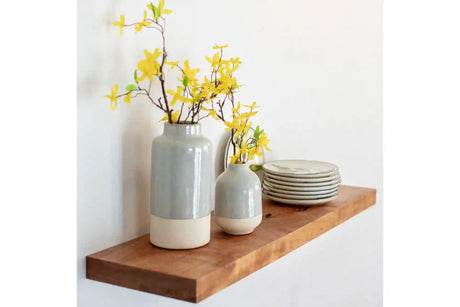
Floating white oak shelves are the most versatile. Warm, neutral grain that doesn't demand attention, which is a good quality in a room where you're trying to focus. Works with light walls, dark walls, modern, traditional, whatever the space is doing.
Black walnut shelves bring a darker, richer tone that reads polished and serious. Pairs well with leather, darker furniture, and mid-century or traditional office aesthetics.
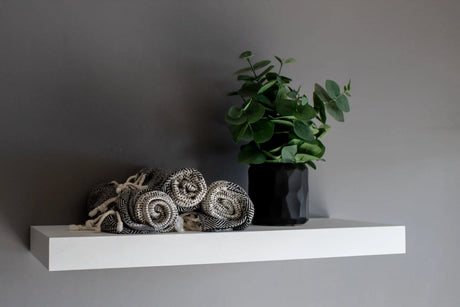
White shelves for wall are the right call when you want the shelf to disappear and let the objects do the talking. Clean, minimal, blends with most wall colors.
For the lightest, most consistent look, maple is worth considering. Pale, even grain that works particularly well in offices with a lot of natural light.
Not sure? I offer samples so you can see the wood in your actual space before committing.
The Video Call Shelf
This one has become more relevant than it used to be. A well-styled shelf behind you on a video call communicates more about your space than any virtual background. Books, a plant, a few personal objects: keep it clean and intentional and it doubles as a professional backdrop every time you're on camera.
If you're thinking about this use case specifically, keep the shelf at roughly head height or slightly above so it appears naturally in frame. One or two shelves is plenty. Overstyle it and it becomes distracting; understyle it and it looks like you mounted a shelf and forgot about it.
Before You Order
A few things to nail down:
- Measure the wall space above or beside your desk, then decide how much of it you want to fill. A shelf that runs the full width of a desk below it creates a cohesive look.
- Match depth to use. 8"-10" for above-desk shelves with books and supplies. 12" if you're storing equipment or large format items.
- If your setup is in a corner, measure both walls and reach out for sizing guidance on the L formation.
- Think about what's going on the shelf before you order. Books, a monitor, speakers, and a printer all have different depth and weight requirements.
Every shelf is custom size floating shelves by default: made to your exact dimensions in any of seven species, shipped free nationwide.
When you're ready to upgrade the office, browse the full floating shelves for home office collection. Solid hardwood, 150 lbs per stud, lifetime guarantee. Built in Charlotte, NC.