
A freestanding bookcase is basically furniture that apologizes for existing. It eats four square feet of floor space, wobbles if you look at it wrong, bows in the middle by year two, and the back panel is always that fake wood texture that peels at the corners. You deserve better. Your books deserve better.
Floating bookshelves eliminate all of it. No floor footprint, no back panel, no wobble. Just your collection on the wall, visible from across the room, held by hardware that doesn't care how many hardcovers you own. I've built wall mounted bookshelves for home offices, living rooms, bedrooms, nurseries, and one customer who filled an entire hallway floor to ceiling. Every single one is still level.
Here's how to plan yours.
Start With the Wall, Not the Books
The mistake most people make is counting their books first and then trying to figure out where to put them. Start the other way around. Pick the wall, measure it, and then figure out how many shelves fit.
What you need to know before ordering:
Wall width. This determines shelf length. A 60" wide wall can handle a single 54" to 60" shelf per row with a few inches of breathing room on each side. A wider wall might call for extra long floating shelves at 72", or two shorter shelves side by side.
Wall height. This determines how many rows you can stack. Floor to ceiling in most homes is 96" (8 feet). Start the bottom shelf at 36" to 48" from the floor and space each one 12" to 14" apart. That gives you four to five rows comfortably, with room at the top and bottom to breathe.
Stud locations. Every shelf mounts into studs. Studs are typically 16" apart, so a 36" shelf hits two studs and a 48" shelf hits three. More studs means more capacity per shelf. A stud finder takes 30 seconds and saves you from guessing.
How Deep Should Bookshelves Be?
This is simpler than people make it. A standard paperback is about 5" deep. A hardcover runs 6" to 9". So:
8" deep handles the vast majority of books comfortably. This is the depth I recommend for most floating bookcase setups. You get room for the book plus a small object in front (a photo, a candle, a small plant) without the shelf projecting too far from the wall.
10" deep if your collection leans toward large format art books, coffee table books, or oversized reference volumes. These need the extra inch or two, and at 10" the shelf still looks proportional on the wall.
6" deep for a dedicated paperback shelf or a kids' shelf with board books and picture books. Slim profile, stays tight to the wall, and the narrower depth makes it easier to see every spine.
Full breakdown by room and use case in the depth guide.
Spacing: How Far Apart to Stack Them
The vertical gap between shelves determines what fits and how the wall looks. Too tight and you can't pull a book out. Too wide and the wall looks empty.
12" apart for standard paperbacks and smaller hardcovers. Snug, efficient, and the wall reads as a solid library.
13" to 14" apart for a mixed collection or taller hardcovers. This gives you clearance to pull a book out without tilting it, and leaves a little visual breathing room between rows.
10" apart for kids' books displayed with covers facing out. Board books and picture books are shorter, so you can tighten the spacing and fit more rows on the wall.
My spacing guide covers the math in detail, including how to calculate even spacing across a wall height so everything looks balanced.
The Weight Math
This is the part that kills most hanging bookshelves. People fill them up, the brackets fail, and six months later the shelf is sagging forward with a crack in the drywall behind it.
Here's the math. A standard hardcover weighs about 1 to 2 lbs. A 36" shelf holds roughly 25 to 35 books depending on thickness. At the heavy end, that's 70 lbs on a single shelf. A 48" shelf packed tight can hit 80 to 140 lbs.
Most floating shelf brackets top out at 30 to 50 lbs. That's one row of paperbacks before you're in trouble. Stack four shelves of hardcovers on a wall and you're asking cheap hardware to hold 300+ lbs across the installation. It won't.
Every shelf I build ships with the Hovr bracket, which holds 150 lbs per stud. A 36" shelf on two studs handles 300 lbs. A 48" shelf on three studs handles 450 lbs. You could fill every shelf to capacity on a full wall bookshelves installation and the hardware wouldn't notice. My post on what causes shelves to sag covers the bracket comparison in detail.

For setups where weight is the primary concern, heavy duty floating shelves with the Hovr system are specifically built for this kind of sustained load.
Full Wall vs. Partial Wall
Full wall bookshelves (floor to ceiling, wall to wall) are dramatic. There's no other word for it. Five to eight rows of books covering an entire wall turns a room into a personal library. It's the kind of thing people photograph and post online, and it's the kind of thing that makes a house feel like a home rather than a place where you sleep.
The install is more involved (more shelves, more stud work, more leveling), but the result is worth it. Every shelf is mounted independently, so if one needs to come down for any reason, the rest stay put.
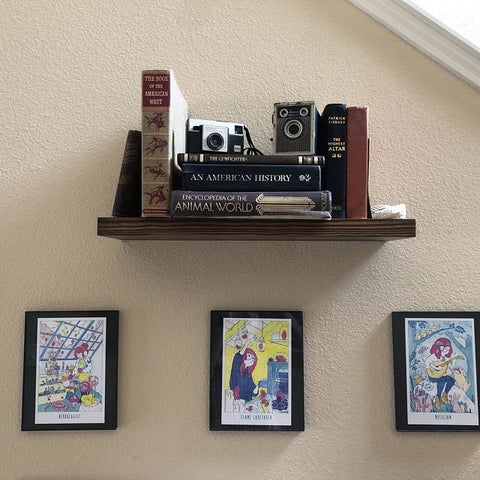
Partial wall (two to four shelves on a section of wall) is the more common setup and the easier starting point. A stack of three shelves above a desk, a reading chair, or a sofa gives you serious book storage without committing to a full library wall. This is also the better option if your wall has a window, a door, or other features that break up the available space.
Either way, plan the layout on paper first. Mark the stud locations, decide on spacing, and dry-fit the heights with painter's tape before you drill. Ten minutes of planning saves a lot of patching later.
Which Wood Species for a Library Wall?
The wood you choose sets the entire mood. A wall of books is already visually busy (all those different spines, colors, sizes), so the shelf itself either calms that down or adds to it.
Walnut is the classic library shelf. Dark, warm, rich grain. It gives the wall weight and makes the whole setup feel serious and permanent. If you're building a home office library or a reading room, walnut is the default for a reason.
White oak is lighter and more neutral. The grain is visible but not dramatic, and it lets the books be the visual focus rather than the wood. Works well in living rooms and bedrooms where the shelves need to blend into the room rather than dominate it.

Maple is the lightest option. Clean, pale, almost blonde. For a modern floating bookcase look in a bright room with a lot of natural light, maple keeps things feeling open.
Cherry starts soft and deepens into a rich reddish tone over time. A full wall of cherry develops character that no other species can match. It's the long game choice, and it rewards patience.
Painted white disappears against light walls and lets the spines do all the talking. Painted black creates bold contrast that works well in modern or industrial spaces.
Not sure? Samples in your actual room lighting are worth more than any product photo.
Bookshelves for Kids
This is one of my favorite setups to build. Wall-mounted bookshelves in a kids' room, mounted low (24" to 30" from the floor), with the covers facing out instead of the spines. A kid is way more likely to grab a book when they can see the cover than when they're staring at a row of spines they can't read yet.
For this setup, go 6" to 8" deep and 24" to 36" wide. Board books and picture books are small enough that you don't need much depth, and the shallow profile keeps the shelf close to the wall and out of the way at kid height.

Nursery floating shelves come in all seven species plus custom paint matching (Benjamin Moore, Sherwin-Williams, or hex codes) if the room has a specific color scheme.
For the full nursery setup (heights by age, covers-out vs. spines-out, and the transition to a big-kid room), the nursery shelf guide covers all of it.
Solid Wood vs. MDF: Why It Matters More for Books Than Anything Else
A shelf holding a candle and a picture frame doesn't care what it's made of. A shelf holding 70 lbs of hardcovers cares a lot.
MDF (medium-density fiberboard) flexes under sustained weight. The middle bows downward, the veneer chips at the edges, and once the sag starts, it doesn't stop. This is the material most mass-produced floating bookshelves are made from, and it's why most of them fail within a year or two of being loaded with an actual collection.

Solid wood floating shelves are denser, stiffer, and dimensionally stable under load. Every shelf I build is 1.8" thick solid hardwood with a polyurethane topcoat and a lifetime guarantee against warping and cracking. For a wall of books you plan to keep for decades, solid wood is the only material that makes sense.
Add Lighting and the Books Glow
LED lighting on the underside of each shelf puts a warm wash of light across the row below. On a full wall of books, the effect is somewhere between a high-end bookstore and a movie set. It highlights the spines, adds depth to the wall, and makes the whole room feel warmer.
I route the LED channel directly into the wood and drill a cord exit through the back. No adhesive strips, no visible hardware. $50 per shelf.
The Home Office Library
If your office doubles as your reading room (and whose doesn't), a stack of home office shelves above or beside the desk creates a personal library that's within arm's reach while you work. Reference books, notebooks, project binders, and the novels you read on lunch breaks all go on the same wall.
Go 10" deep for this setup so you have room for larger reference volumes and binders alongside standard books. 36" to 48" wide per shelf, stacked three to five rows, and suddenly the home office has more storage than the cubicle you left behind.
Sizing Quick Reference
Standard book wall: 36" to 48" wide, 8" deep, 12" to 14" spacing Large format / art books: 36" to 48" wide, 10" deep, 14" spacing Paperback shelf: 24" to 36" wide, 6" deep, 12" spacing Kids' shelf (covers out): 24" to 36" wide, 6" to 8" deep, 10" spacing Full wall installation: match wall width, 8" deep, 12" to 13" spacing, 5 to 8 rows
Every shelf is custom sized to your wall. Measure the space, pick the species, and I'll build it to fit.
The freestanding bookcase had its run. It held your collection for years, wobbled every time you pulled a book out, and slowly turned that corner of the room into dead space. Wall mounted bookshelves give you the same storage with zero floor footprint, better weight capacity, and a look that makes the room feel like it was designed, not just furnished.
Browse the full floating bookshelves collection to see all seven species and start planning your wall.