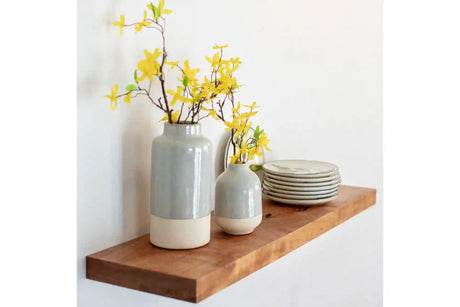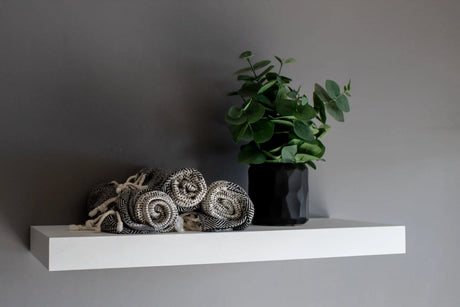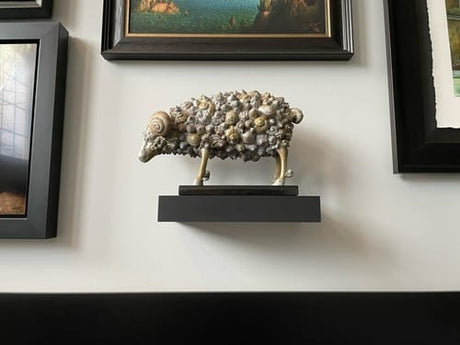

Every room has one. That corner where two walls meet and nothing happens. Maybe there's a plant on the floor. Maybe there's nothing at all. It's the most underused real estate in your home, and it's been staring at you for years.
Floating corner shelves turn that dead space into something functional and intentional. But a corner setup has a few more moving parts than a single wall shelf. Two shelves, two walls, and some math that's easy to get wrong if you don't think it through before ordering. Here's everything you need to know to get it right.
How Corner Shelves Actually Work

I don't make triangular corner shelves or single L-shaped units. What I build are standard rectangular floating shelves in solid hardwood, and for a corner setup, you order two of them and install them on adjacent walls.
The Hovr bracket slides on the hardware, which means you can push each shelf tight into the corner until they meet. No mitering, no custom corner fabrication, no special hardware. Two independent shelves that look like one seamless installation once they're up.
This is important because it means you have full flexibility on sizing. Each shelf is its own piece, made to your exact dimensions. You're not locked into whatever pre-made corner unit a manufacturer decided to build.
L Formation vs. Staggered: Which One Fits Your Room?
These are two completely different looks, and the room should drive the decision more than personal preference.
The L formation puts both shelves at the same height, butted together where they meet at the corner. From across the room, it reads as one continuous shelf wrapping the wall. This is the cleaner, more built-in look. It works best in rooms where the corner is a primary focal point and you want maximum storage or display area in a compact space.
Best applications for L formation: kitchen corners above a countertop or sink, wall mounted bar shelves wrapping a corner for a spirits display, office corners where you want a continuous run of books or supplies, and dining room floating shelves filling an otherwise awkward corner near a table.

The staggered configuration puts each shelf at a different height on its adjacent wall. Nothing touches. The result is a cascading, asymmetric look that fills a corner without requiring precise alignment. This is more forgiving on measurements and more visually dynamic.
Best applications for staggered: living room corners where a floating shelf above the sofa on one wall pairs with a higher shelf on the adjacent wall, bedroom corners where floating shelves for closet areas or beside a bed need display without bulk, and bathroom corners where floating shelves above the toilet on one wall pair with a smaller shelf on the perpendicular wall.

If you're not sure which configuration suits your space, a simple test: stand in the corner and look at the two walls. If they're roughly equal in length and the corner is a natural focal point, go L formation. If one wall is significantly longer than the other or the corner is more of a transition space between zones, go staggered.
The Math: How to Measure for an L Formation
This is the part people get wrong most often, and it's the single most important thing to nail before ordering.
In an L formation, one shelf runs all the way to the corner wall. The other shelf meets it from the side. Here's the catch: the shelf running into the corner occupies wall space on the adjacent wall equal to its own depth. If shelf A is 10" deep and runs to the corner, it's eating 10" of shelf B's wall space.
So the formula is simple: measure the wall run for shelf B, then subtract the depth of shelf A from that measurement. That's your order length for shelf B.
Real example: Wall A is 36". Wall B is 48". Both shelves are 10" deep. Shelf A orders at 36". Shelf B orders at 48" minus 10" = 38". You now have two shelves that meet cleanly at the corner with no overlap and no gap.
One more step: measure both the front and the back of each wall run. Nothing in a house is perfectly square, and those numbers are almost always different. Use the shorter of the two measurements, then subtract an additional 1/8" from each shelf. That leaves 1/16" of clearance on each end and makes installation dramatically easier. A shelf cut exactly to the span will fight you; a shelf cut 1/8" short slides right in. For more on this, Size Matters covers the full approach to measuring for any shelf installation.
If the math feels uncertain at all, reach out before ordering. I'd rather spend five minutes on email confirming dimensions than build shelves that don't fit.
Measuring for a Staggered Configuration
This is simpler. Since the two shelves don't touch, there's no depth subtraction. Measure each wall run independently, decide how long you want each shelf, and order accordingly.
The only decision is vertical spacing. There's no hard rule, but most staggered installs look best with 8" to 16" between the two shelves. Tighter spacing creates a more cohesive grouping. Wider spacing lets each shelf breathe as its own element. It depends on what you're displaying and how much visual weight you want the corner to carry.
Depth Matters More in a Corner
In a corner setup, depth affects more than just how much the shelf holds. It determines how the two shelves interact in an L formation and how much each shelf projects into the room's sightlines.
For kitchen corners, 10" to 12" deep makes sense. You want real surface area for dishes, cookware, and supplies. Kitchen open shelving in a corner replaces upper cabinets in a spot where cabinets are notoriously awkward anyway.
For living rooms and bedrooms, 8" to 10" is usually the right call. Deep enough for books, plants, and display objects without the shelves projecting too far into the room.
For bathrooms, 6" to 8" keeps things proportional to the smaller wall space. Toiletries, small plants, and a couple of towels don't need more than that.
For a full breakdown of how depth shapes function across every room, read how deep should a floating shelf be.
Why Corners Put Your Shelf Material on Display
A corner installation gets viewed from more angles than any single wall shelf. You see the front face of one shelf and the end grain of the other simultaneously. The junction where two shelves meet is visible from across the room. Any flaw in material, finish, or edge quality is amplified.
This is where MDF and veneer shelves fall apart (sometimes literally). The corners and edges are the first place veneer chips. The end grain exposure shows the particle board core. In a setup where both shelves are on full display from multiple sightlines, those failures are impossible to hide.
Every shelf I build is 1.8" solid hardwood, finished with a polyurethane topcoat, backed by a lifetime guarantee against warping and cracking. Both shelves of a corner pair will look exactly the same in ten years as they do the day you install them. For more on what separates solid hardwood from hollow core and MDF under real loads, read the floating shelf weight capacity breakdown.
Species for Corner Setups
In an L formation, grain consistency across both shelves matters more than on a standalone shelf. Here are the species that handle that best:
Painted white or painted black creates the most seamless L formation because the uniform finish eliminates any grain mismatch at the junction. If you want the corner to read as one continuous piece, a painted finish is the cleanest path.
White oak has warm, consistent grain that reads as cohesive across two shelves. It's the most popular species for corner setups, especially in kitchens.
Walnut creates dramatic contrast against light walls. The dark tone turns a dead corner into a genuine focal point. For a bar or home office floating shelf corner, it's hard to beat.
Cherry deepens over time into a warm reddish tone. For a dining room or living room corner, it develops character that suits the space over years.
Maple keeps things light, clean, and modern. It works well in bright kitchens and offices where you want the shelving to recede rather than command attention.
Not sure? I offer samples so you can see the wood in your actual space before committing.
Before You Order
Quick checklist:
- Decide L formation or staggered based on your room and the corner's role
- Measure each wall run independently, front and back
- For L formation: subtract the depth of the intersecting shelf from one measurement
- Subtract 1/8" from each shelf for clearance
- Choose depth based on what you're storing and the room scale
- Include a note in the order notes that it's a corner setup with both dimensions so I can confirm the math before building
If you're unsure about anything, reach out first. Corners have more variables than a single wall shelf, and getting the dimensions right before ordering saves everyone time.
Browse the full corner floating shelves collection to see what's available. Two shelves, one corner, solid hardwood, 150 lbs per stud. Handmade in Charlotte, NC.