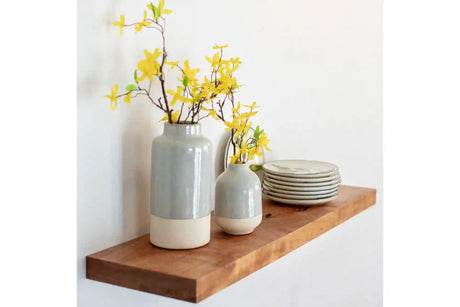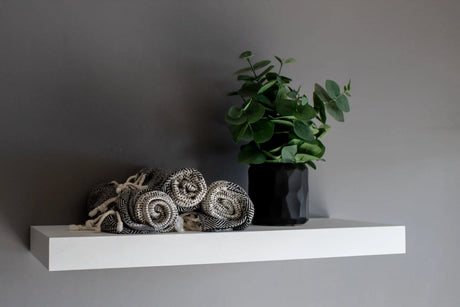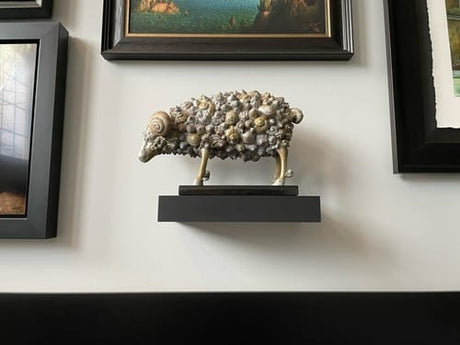

The nursery is the one room in the house where the shelves change jobs every year. What starts as a display shelf for stuffed animals and a framed birth announcement becomes a book shelf your toddler raids six times a day, and eventually becomes storage for chapter books and art supplies in a room that doesn't feel like a nursery anymore. Nursery floating shelves need to work at every stage, which means getting the height, depth, and layout right from the start matters more here than in any other room.
Here's how to plan a setup that doesn't need to be ripped off the wall and redone every time your kid hits a new milestone.
The Three Heights That Cover Every Stage
Most nursery shelf setups use two or three shelves at different heights, each doing a different job. Rather than guessing, plan around these three zones.
Low Shelves: 24" to 30" From the Floor
This is the kid-access zone. Once they can stand and walk, this is where they go. Board books displayed covers-out, a few stuffed animals, maybe a basket of small toys. The goal is independence: a toddler who can see a book cover and grab it without asking for help is a toddler who "reads" more often.
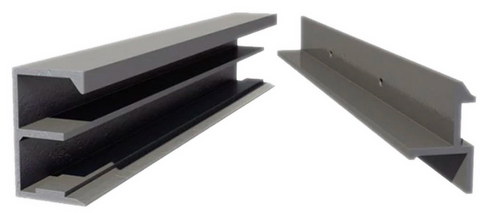
Go 6" to 8" deep here. Board books are about 5" deep, and the slim profile keeps the shelf tight to the wall at a height where small humans are walking, bumping, and occasionally hanging. That last part is not optional. It will happen. The Hovr bracket holds 150 lbs per stud, so the shelf won't pull out of the wall when your kid decides it's a chin-up bar. The hardware can handle it even if your nerves can't.
For length, 24" to 36" is the sweet spot at this height. Wide enough for 10 to 15 board books face-out, narrow enough to fit the scale of a nursery wall.
Mid Shelves: 48" to 54" From the Floor
Parent-access height. Diaper supplies, wipes, a small lamp, the white noise machine, a basket of extra blankets. Anything you need to reach quickly during a 2 AM change without turning on the overhead light.
Go 8" to 10" deep at this height. The shelf is doing functional work here, not just display, so the extra depth gives you room for a small basket or a white noise machine without things hanging over the edge.
High Shelves: 60"+ From the Floor
Display only. Framed prints, sentimental objects, the stuffed animal from the baby shower that's too nice for the floor. These shelves make the room feel finished and personal without putting anything breakable within reach.
Go 6" to 8" deep. These are decorative, so slim is fine. The spacing guide covers vertical math if you're stacking two or three shelves across these zones.
Covers Out vs. Spines Out
This is the nursery shelf debate that every parent encounters. The answer depends on the age.
Under 3: covers out. A toddler picks books by what they look like, not what the spine says. A shelf of board books with the covers facing the room gets way more engagement than a shelf of unreadable spines. At 6" deep, a single shelf holds 10 to 15 board books face-out. Rotate them monthly (put some in a bin, bring others out) so the shelf doesn't look like a library return cart.
3 to 5: mix of both. Picture books are taller and thinner than board books. Some fit face-out, some fit better spine-out. A 36" shelf at 8" deep can hold five or six picture books face-out, or a dozen spine-out. Most parents end up doing a mix: favorites face-out, the rest spine-out behind them.
5+: spines out. At this point they can read titles (or at least recognize them), and the collection has grown past what face-out display can handle. This is where floating wall bookshelves stacked vertically start making sense. Two or three shelves at 8" deep, spaced 10" to 12" apart, holding 30 to 50 books total.
The Nursery-to-Bedroom Transition

Here's the part most people don't think about until it's too late. The nursery becomes a toddler room becomes a kid's room. If the shelves are mounted at display-only heights (all above 48"), you'll be moving them down when the kid starts wanting to reach things. If they're mounted too low for the newborn phase, they look wrong for the first two years.
The best approach: plan for both. Install two shelves from the start. One at display height (48" to 54") for the infant phase, and one at kid-access height (24" to 30") that sits empty or holds a few soft items until the kid is mobile. When they start walking, the low shelf is already there waiting for books. The high shelf transitions from supplies to decor.
When the room eventually stops being a nursery, the same shelves work as they grow into a big-kid room. A 24" shelf that held board books at age two holds chapter books at age seven. The Hovr bracket doesn't care what's on the shelf; the hardware outlasts every phase.
Which Wood for a Nursery
Nursery design tends to go one of three directions, and the wood choice follows.
Light and neutral: Maple is the most natural fit. Pale, consistent grain, no visual competition with the decor on the shelf. It pairs with white furniture, light walls, and the soft color palettes most nurseries lean toward.
Warm and earthy: Cherry starts soft and deepens into a rich amber over years of light exposure. If the room is going to transition from nursery to bedroom to reading room, cherry grows into each version of the space in a way that no other species can. It rewards patience.
Clean and minimal: Painted white disappears against light walls and lets the books, frames, and stuffed animals do all the talking. This is the easiest option when the nursery has a lot going on visually.
Modern contrast: Painted black against a light wall creates a bold line that reads as intentional. Less common in nurseries but increasingly popular in modern and gender-neutral rooms.
Custom Paint Matching
Most nursery walls aren't plain white. There's a specific sage green, a dusty rose, a muted blue that took three trips to the paint store and four sample pots to get right. Standard white or black shelves might clash with what you've already committed to on the walls.
I offer custom paint matching on any shelf. Bring a Sherwin-Williams or Benjamin Moore color code, a hex value, or even a swatch, and I can match it for an additional fee. It's one of those details that makes a nursery feel like every piece was chosen together rather than assembled from whatever was in stock.
Not sure which finish works in your room? Order a sample and hold the actual material against your actual wall in your actual lighting before committing.
Sizing for Small Rooms
Nurseries are usually the smallest bedroom in the house, which means shelf placement needs to be more deliberate than in a living room or kitchen where you've got wall space to spare.

A few guidelines for tight spaces:
Go 6" deep instead of 8" if the shelf is on a wall near a door or closet where you walk past frequently. The slim profile keeps it from feeling like it's jutting into the room.
Keep lengths between 24" and 36" unless you've got a long, uninterrupted wall. A 48" shelf on a wall that's only 60" wide looks crammed. Shelves built to the exact width of the wall with 2" to 3" of breathing room on each side look proportional.
If the crib is against one wall, put the shelves on the wall you see when you walk in. That's the visual centerpiece. Shelves abo

ve a crib are fine structurally (the Hovr bracket isn't going anywhere), but many parents feel more comfortable with the shelves on an adjacent wall. Either works. Go with whatever lets you sleep.
For more styling ideas on small bedroom walls (and other tight spots throughout the house), see ideas for awkward small walls.
For full depth recommendations by room and use case, the depth guide has the breakdown.
Build the Nursery Wall
The nursery is temporary. The shelves don't have to be. Solid hardwood on the Hovr bracket at 150 lbs per stud stays level through the newborn phase, the toddler phase, the "I can reach that" phase, and whatever comes after.
Browse the full nursery wall shelves collection in all seven species. Every shelf is built to order, ships with the bracket and all mounting hardware, and comes with a lifetime guarantee against warping and cracking. Pick the wood, measure the wall, and I'll build it to fit.