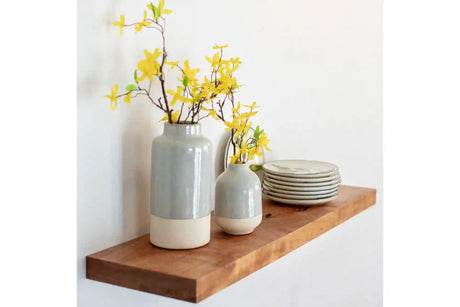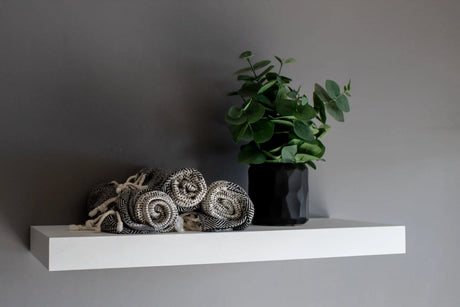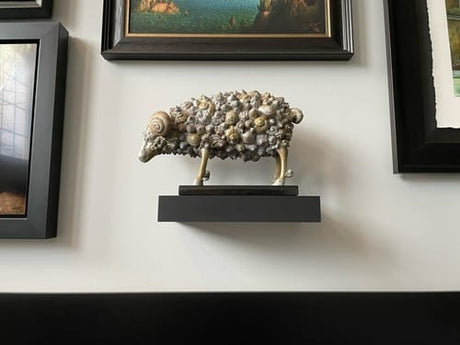

Every house has a landing zone. It's the spot right inside the front door where keys get dropped, jackets get tossed, mail gets stacked, and the dog leash ends up draped over whatever surface is closest. In most homes, that surface is the top of a shoe, a counter that's already full, or the floor. Entryway floating shelves give that chaos a home. One shelf, a few hooks, and suddenly everything that comes through the door has a place instead of a pile.
Here's how to set it up so it actually works for the way you live, not just the way it photographs.

The Shelf-and-Hook Setup
This is the configuration that makes entryway shelves more useful than any coat rack, hall tree, or console table. A single shelf mounted at 60" to 66" from the floor with hooks screwed directly into the underside. The shelf holds the small stuff (keys, sunglasses, wallet, mail, a small plant). The hooks handle the big stuff (coats, bags, scarves, the leash).
The reason this works better than a standalone coat rack: it takes up zero floor space. No legs, no base, no footprint. In a narrow entryway where every inch of walking path matters, that's the difference between feeling organized and feeling cramped.
Go 36" to 48" long and 8" to 10" deep. That gives you enough shelf surface for a catch-all tray and a few items, and enough underside real estate for four to six hooks spaced 6" to 8" apart. Any standard screw-in coat hook works here because the shelf is solid hardwood, 1.8" thick all the way through. Drill a hook into MDF and the material crumbles around the screw hole within weeks. Drill it into solid white oak or walnut and it holds a loaded winter coat for the life of the shelf.
That's the detail that separates a shelf you can hang things from and a shelf that's just a surface. The wood is built by hand from solid hardwood, which means you can mount hardware anywhere on it and trust it to hold.
Size It to the Space
Entryways are rarely generous. The wall between the front door and the first room might be 30" wide. The hallway might be 36" across. You're working with whatever the builder left you, and oversized shelves make small spaces feel smaller. For more on styling tight spots, narrow strips, and the awkward walls a lot of entryways have, check out 12 ways to style a small wall.
Depth: 6" is the right call for tight hallways and narrow entryways where the shelf can't project far without eating into the walking path. 8" if you have a bit more room and want space for a basket or a wider tray. 10" only if the entryway is open enough that the shelf won't feel like it's jutting into the space. The depth guide covers the full breakdown by room.
Length: Match the wall. A shelf that runs the full width of a 30" wall (with 2" to 3" of breathing room on each side) looks intentional. A 24" shelf on a 48" wall looks like it's floating in no-man's-land. Every shelf is sized to the wall at any length from 12" to 72", so you're not rounding to the nearest standard size and hoping it fits.
Height: 60" to 66" from the floor for a shelf with hooks underneath. That puts the shelf surface at a comfortable reach for setting keys down, and the hooks at a height where coats hang without dragging on the floor. If you're tall (or live with tall people), push toward 66". If the hooks are for kids, add a second shelf at 36" to 42" so they can reach their own coats.
Organized by Household
Different households use the entryway differently. Here's what actually works for each.
The Solo Setup
One person, one routine. A single shelf at 36" long, 8" deep, with three hooks underneath. One hook for the everyday jacket, one for a bag, one spare. On the shelf: a key tray, sunglasses, and whatever you grab on the way out. This is the simplest setup and it takes about 30" of wall space total.
The Couple Setup
Two people means double the coats, double the keys, double the "have you seen my..." conversations. Go 42" to 48" long with four to six hooks. Put a divided tray or two small trays on the shelf (one per person) so keys and wallets don't get mixed. It sounds minor, but separate trays eliminate the daily shuffle.
The Family Setup
Kids change the math. Coats multiply, backpacks are heavy, and everything needs to be reachable at kid height. Stack two shelves: one at adult height (60" to 66") with hooks for adult coats, and one at kid height (36" to 42") with smaller hooks for their jackets and backpacks. The spacing between shelves guide covers vertical layout if you're fitting both on the same wall.
The lower shelf needs to hold a loaded backpack without flinching. A kid's school backpack full of textbooks can hit 15 to 20 lbs. Multiply that by two or three kids and you're asking the hooks to handle real weight. The Hovr bracket at 150 lbs per stud doesn't care. Cheap brackets would.

The Dog Owner Setup
Everything in the couple or solo setup, plus a dedicated hook for the leash and a shelf spot for treat bags or poop bag dispensers. The leash hook should be on the end closest to the door so you're not reaching across the shelf on the way out. Sounds like a small detail. You'll appreciate it on rainy mornings.
Hallways: The Walls Nobody Uses
The hallway between the front door and the rest of the house is the most underused wall space in most homes. Long, narrow, blank. People hang one photo and forget the rest exists.
A single shelf running part of the hallway wall, 6" deep and 36" to 48" long, turns dead wall space into something worth looking at. Mount at eye level (57" to 60" from the floor) and keep it simple: a few small framed photos, a candle, a tiny plant every few feet if you're running multiple shelves. The narrow depth keeps it from blocking the walkway, and the display breaks up the tunnel effect that long hallways create.

For hallway shelves, maple or painted white keeps things light in a space that's usually short on natural light. Darker species like walnut look great but can make a narrow hallway feel heavier. Match the hallway to the room it connects to: if the living room around the corner has warm tones, carry that warmth into the hallway with white oak or cherry. If it's bright and modern, maple or painted white continues that line.
The Entryway Corner
If your entryway has a corner where two walls meet near the door, a pair of corner shelves butted together turns dead space into a functional landing zone. Two shelves, one on each wall, pushed tight together at the corner. The Hovr bracket slides on the hardware so you can get a clean joint with no gap.
Go 24" per side at 8" deep. That's enough surface for a key tray on one side and a small plant or photo on the other, with hooks underneath for a coat and a bag. It's the setup for entryways that don't have a long wall to work with but still need a landing spot.

Which Wood for an Entryway
The entryway sets the tone for the rest of the house. It's the first wood someone sees when they walk in, so it's worth thinking about how it connects to what comes next.
White oak is the safest pick for most homes. Warm, neutral grain that works with light or dark walls, modern or traditional hardware, and bridges naturally into whatever room is adjacent. Its closed grain structure also handles the humidity swings that come with an exterior door opening and closing all day.
Walnut makes a statement. Dark grain against a light wall creates contrast that reads as deliberate and sets an expectation for the rest of the home. If you want the entryway to feel designed rather than default, walnut does that.
Maple keeps things bright. In a small or dark entryway, pale wood reflects more light than it absorbs and makes the space feel bigger than it is.
Painted white or black shelves work well when the hooks and objects on the shelf are the visual focus, not the wood itself. White blends into light walls. Black creates a sharp line that works in modern spaces.
One Shelf Changes the Whole Entrance
The entryway was an afterthought. The builder put up a wall, hung a door, and moved on. Everything that's happened since (the key bowl on the floor, the jackets over the chair, the mail on the counter) has been improvisation.
One shelf and a few hooks turns improvisation into a system. Browse the full entryway wall shelves collection in all seven species. Every shelf is solid hardwood, built to your exact dimensions, and ships with the Hovr bracket at 150 lbs per stud. Pick the wood, measure the wall by the door, and I'll build it. The pile by the front door has had its run.