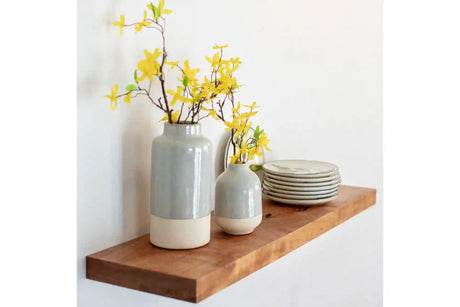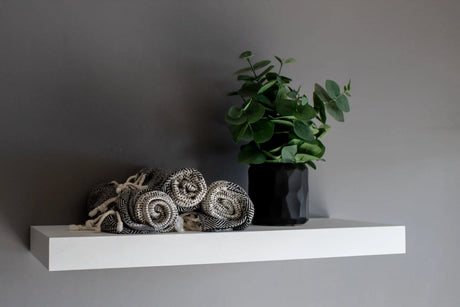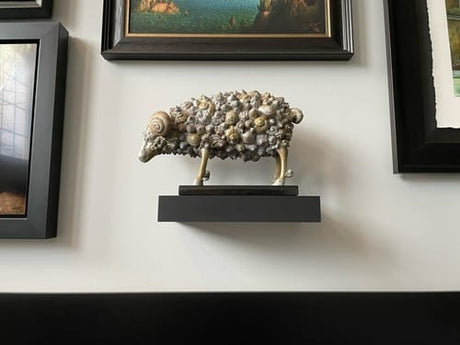

Three hundred pounds. That's the load capacity of every shelf I build. To put that in perspective: it's roughly 30 house cats, 150 cans of soup, or one very committed record collection. The point isn't that you're going to load a shelf with 300 lbs of anything. The point is that when a shelf is built to hold 300 lbs, you never have to think about weight again.

Most floating shelves can't say that. In fact, most floating shelves are quietly lying to you about what they can handle. If you're shopping for heavy duty floating shelves, here's what you actually need to know before you buy.
What Most Shelves Get Wrong About Load Capacity
Walk through any home goods store or scroll through Amazon long enough and you'll see floating shelves marketed as "heavy duty," "industrial strength," or "professional grade." Then you read the fine print: rated for 25 lbs. Maybe 50 lbs if you're lucky.
That's not high capacity. That's a picture frame and a candle.
The problem is almost always the bracket. Most shelves use prong or rod-style brackets: a few metal rods that stick out from the wall and slide into holes drilled in the back of the shelf. The shelf sits on the rods. The rods hold the weight. And those rods are doing all the work from a single contact point, which means the load is concentrated rather than distributed.

Under light loads, this works fine. Under real loads, those prongs bend, loosen, and eventually start pulling out of the wall. The shelf droops. Then it droops more. Then one day it doesn't anymore because it's on the floor.
The Problem With Box Shelves
There's another category worth calling out: box shelves. These are the thicker floating shelves you see at mid-range furniture stores, constructed by miter-folding plywood into a hollow box shape. They look substantial. They're not.
The issue is structural. With a box shelf, the bracket and the shelf are two separate things. The bracket mounts to the wall, the shelf slides over it, and the connection between the two is doing the real work. Under heavy loads, that connection is the weak point. The bracket flexes, the shelf shifts, and you end up with a gap between the shelf and the wall, or worse, the whole thing pulling away from the studs.
It's the same fundamental problem as prong brackets, just disguised by extra thickness.
Why the Hovr System Is Different
Every shelf I build uses the Hovr Bracket System, and the difference comes down to one thing: the bracket and the shelf become a single unit.

The Hovr bracket is mortised directly into the shelf during construction. It doesn't slide into pre-drilled holes. It doesn't sit underneath the shelf or clamp onto it. It's built into the shelf itself, so when the shelf is on the wall, you're not looking at a bracket holding a shelf. You're looking at one integrated structure anchored to your studs.
That matters because load distribution works completely differently. Instead of a few contact points carrying all the weight, the entire bracket length shares the load evenly across the wall. For longer shelves, the bracket spans enough distance to hit three or more studs. Three studs at 150 lbs each means you have more holding power than you will ever realistically need.
For the full technical breakdown, the Hovr bracket page has everything.
The 300 lb Number, Explained
Here's how the math actually works: the Hovr bracket is rated at 150 lbs per stud. Standard wall studs are spaced 16" on center. A typical shelf hitting two studs gives you 300 lbs of capacity. A longer shelf hitting three studs gives you 450 lbs.
I advertise 300 lbs because that's the realistic number for most installations, and it's a number I'm comfortable standing behind. The capacity doesn't change with shelf depth either. Whether you order a 6" deep shelf or a 12" deep shelf, the bracket rating is the same.
To put 300 lbs in real terms: that's a full set of cast iron cookware with room to spare. That's several hundred vinyl records. That's a row of hardcover books across a 48" shelf, fully loaded, with space for more. That's the kind of capacity where you stop thinking about weight entirely and just use the shelf.
For a deeper dive into how depth and load interact across different applications, the floating shelf depth guide is worth a read.
Why Solid Hardwood Is Non-Negotiable
The bracket is only half the equation. The shelf material matters just as much, and this is where a lot of so-called load-bearing shelves fall apart even when the bracket is decent.
MDF is the most common shelf material on the market. It's cheap, it's consistent, and it looks fine in photos. Under sustained heavy loads, it sags. The fibers compress over time and the shelf develops a permanent bow in the middle. No bracket in the world fixes a shelf that's bending under its own load.
Plywood box shelves have similar issues at heavy loads. The hollow construction means the shelf face is doing structural work it wasn't designed for.
Every shelf I build is solid wood floating shelves: solid hardwood all the way through, seven species, made to order. Solid hardwood doesn't compress under load the way MDF does. It doesn't flex or bow. The same properties that make hardwood a structural material in furniture and flooring make it the right choice for a shelf that's actually going to hold something.
Where Shelf Capacity Actually Matters
Kitchen: This is the most demanding application. Cast iron pans, small appliances, stacks of plates, bulk oils: kitchen floating shelves take more abuse than almost any other room in the house. A shelf that can handle a 12" cast iron skillet and a row of cookbooks without thinking twice is the baseline here, not a luxury.

Living room: Books are heavier than people realize. A 60" shelf loaded with hardcovers can hit 80-100 lbs without breaking a sweat. Living room floating shelves holding record collections, display pieces, or anything ceramic need real capacity behind them. And if you're putting floating shelves above the couch, you want zero doubt about what's holding them up.
Bedroom: A shelf above a bed holding books, plants, ceramics, or a lamp is carrying more than people expect, and the stakes of it coming down are higher than most rooms. Bedroom floating shelves are one place where capacity isn't a nice-to-have.
Nursery: This one surprises people. A 25 lb toddler grabbing the edge of a shelf and pulling up on it is applying real lateral force to the wall mount. Because the Hovr bracket is anchored directly into studs and mortised into the shelf itself, the shelf isn't going anywhere. Nursery floating shelves built on this system are as secure as anything else on the wall.
Home office: Monitors, external drives, reference books, equipment: office floating shelves in a working setup carry more weight than a decorative shelf ever would. The last thing you want is a drooping shelf above your desk.
Laundry room: Detergent, fabric softener, and bulk supplies are dense and heavy. Laundry room floating shelves are a practical application where capacity matters more than aesthetics.
Bar: Full bottles of liquor are surprisingly heavy. A bar floating shelf holding eight to ten bottles plus glassware is carrying real weight. This is not a job for prong brackets.
Floating bookshelves: If the entire point of the shelf is books, capacity isn't optional. Floating bookshelves need to be built for the load, full stop.
What to Look For When You're Shopping
If you're evaluating any floating shelf for real load capacity, ask these questions:
- What's the bracket system? Prong/rod style brackets won't cut it regardless of what the listing says. Look for a bracket that spans the full length of the shelf and anchors to multiple studs.
- What's the shelf material? MDF and hollow core box construction are not suitable for heavy loads. Solid hardwood is.
- How does the bracket connect to the shelf? If the bracket and shelf are two separate components that just slide together, that connection is your weak point. The strongest systems integrate the bracket into the shelf itself.
- What's the per-stud rating, not just the total rating? A shelf rated at 300 lbs hitting one stud is very different from one rated at 300 lbs hitting two studs at 150 lbs each.
The Shelf Expression Approach
Every shelf I build is solid hardwood, Hovr-equipped, and backed by a lifetime guarantee against warping and cracking. The capacity is 150 lbs per stud, the bracket is mortised into the shelf, and the whole thing is made to order in Charlotte, NC.
I build seven species: walnut, white oak, maple, cherry, live edge walnut, painted white, and painted black. White oak floating shelves are probably the most popular choice for high-capacity kitchen applications, partly because white oak's natural density pairs well with the Hovr system and partly because it looks incredible above a range. Walnut floating shelves are a close second for living rooms and offices where the darker tone works better.
If you want something lighter in color, maple floating shelves are extremely dense for their appearance and hold up beautifully under load. For a painted finish, black floating shelves are a popular choice in kitchens and bars where the contrast works well against light cabinetry. And if you want something with genuine character, live edge floating shelves carry the same 300 lb capacity as every other species I build.
Every shelf is custom floating shelves by default: made to your exact dimensions, 6" to 12" deep and 12" to 72" long, in whichever species fits your space.
When you're ready to stop second-guessing your shelves, browse the full sturdy floating shelves collection. Solid hardwood, 300 lb capacity, lifetime guarantee. Built to hold whatever you throw at it, including 30 house cats if that's where your life is headed.