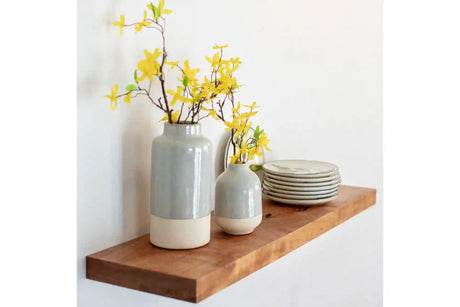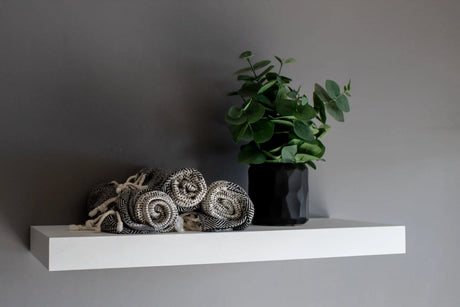

Here's a fun experiment: go to any major furniture retailer's website and search for "wood floating shelves." Count how many results are actually made of wood. Real, solid, came-from-a-tree wood. Not "engineered wood." Not "wood-look finish." Not "wood-tone laminate," which is corporate speak for "plastic that wishes it were a tree."
The answer is almost none of them. And that matters, because the material inside your shelf determines everything: how long it lasts, how much weight it holds, whether it sags in six months, and whether it still looks good in ten years. Here's what you need to know about what's actually inside the box.
The Material Lineup: What's Actually Out There
MDF (Medium Density Fiberboard): This is the most common shelf material on the market. It's made from wood fibers glued together under heat and pressure, then wrapped in a veneer or painted surface. It's cheap, consistent, and photographs well. It also sags under sustained loads, absorbs moisture like a sponge, and chips at the edges with regular use. If you've ever owned a shelf that developed a slow, sad bow in the middle over a few months, it was almost certainly MDF.
Plywood: Better than MDF, but still a compromise. Plywood is layers of thin wood glued together with alternating grain directions, which gives it decent structural strength. The problem for shelves is the exposed edges: plywood edges show the lamination layers, so they're typically covered with edge banding or veneer. That banding peels over time, especially in kitchens and bathrooms where moisture is present.
Particleboard: The bottom of the barrel. Wood chips and sawdust glued together. If MDF is the shelf material that tries, particleboard is the one that gave up. It's found in the cheapest flat-pack shelving and has no business holding anything heavier than regret.
Solid hardwood: This is what I use. A single piece of wood, milled to thickness, finished, and built to last. No layers, no filler, no veneer to peel. The grain runs the full length of the shelf, the edges are solid wood all the way through, and the material gets stronger relative to its competition the longer you own it. MDF degrades. Solid hardwood develops a patina.

Why Material Matters More Than Most People Think
The shelf you put on your wall is doing structural work. It's cantilevered off the wall with no support underneath, holding weight across its full span. That's a demanding application for any material, and it's where the differences between MDF and solid hardwood stop being theoretical.
MDF compresses under sustained load. The fibers slowly give way, and the shelf develops a permanent bow. This isn't a question of if; it's a question of when. A lightly loaded MDF shelf might last a couple years before it's visible. A heavily loaded one starts showing within months.
Solid hardwood doesn't compress the same way. The grain structure distributes force along the length of the board, and the density of species like white oak, walnut, and maple means the shelf maintains its shape under loads that would destroy MDF. Combined with the Hovr bracket system at 150 lbs per stud, you're looking at a shelf that holds heavy duty wall shelves loads without flex, bow, or movement over time. Install into 2 studs and that's 300 pounds. Or 30 adult cats.

For the full breakdown on how brackets and material interact under load, read the weight capacity guide.
The Seven Species I Build With
Every shelf I make is solid hardwood, made to order. No MDF, no plywood, no veneer. Here's what each species brings to the table (or the wall, technically).
White oak floating shelves are the most popular species I sell. Warm, neutral grain with subtle ray fleck that catches light at certain angles. White oak is naturally dense, resistant to moisture, and works in virtually any room. If you're not sure what species to choose, this is the safe bet that never disappoints.

Dark walnut shelves are the dramatic option. Rich brown tones, straight grain, and a depth that makes lighter walls pop. Walnut reads as luxurious without being heavy-handed. It's the species people choose when they want the shelf to be a statement piece.
Solid maple floating shelves are the lightest species in the lineup. Pale, consistent grain with a clean, modern look. Maple is also one of the densest domestic hardwoods, which means it handles heavy loads exceptionally well despite its lighter appearance. Don't let the color fool you.

Cherry wood shelves start as a soft pinkish-brown and deepen into a warm amber over time. Cherry is one of the few species where the shelf genuinely looks better five years in than it did on day one. If you like the idea of your shelves aging with character, cherry is the pick.
Live edge shelves keep the natural bark edge of the walnut slab, giving each shelf an organic, one-of-a-kind profile perfect for a rustic shelves for wall setup. No two live edge shelves look the same. This is the species for people who want their shelf to start conversations.
White floating shelves are solid hardwood with a painted finish. Clean, minimal, and designed to blend with the wall rather than contrast against it. The painted surface hides the grain, which means these shelves let whatever's on them do the talking.
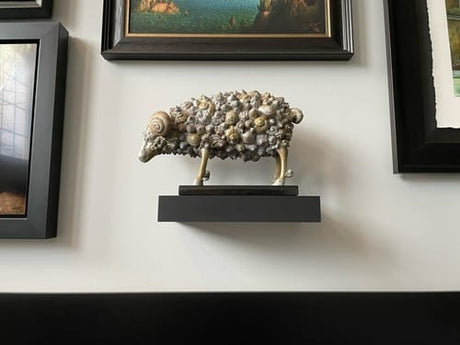
Black wall shelves are the same solid hardwood construction with a black painted finish. High contrast against light walls, sharp and graphic. Popular in kitchens and bars where the shelf needs to stand out.

Want to see these in person before committing? I offer samples so you can hold the actual wood in your actual space under your actual lighting. Photos on a screen only get you so far.
Finishes and Protection
Every hardwood shelf ships with a polyurethane topcoat that protects the wood from moisture, stains, and daily wear. This is a durable, slightly warm finish that enhances the natural grain without looking plastic or glossy.
White oak and walnut can also ship unfinished if you want to apply your own stain or finish to match existing millwork. Cherry and maple are available unfinished as well. If you're trying to match a specific Minwax or Varathane color, send me the stain name or a photo of what you're matching and I'll help you figure out the best approach.
For a closer look at the finishing process and options, the finishes we use page has the details. For more on the wood itself, species characteristics, and grain patterns, check out the wood we use.
How to Tell What a Shelf Is Actually Made Of
Most product listings don't make it easy. Here's what to look for:
Red flags that it's not solid wood: "Engineered wood," "wood composite," "wood-look," "laminate finish," "MDF core," "hollow core construction," or any listing that describes the finish material separately from the core material. If the listing says "walnut veneer over MDF," that's an MDF shelf wearing a walnut costume.
Green flags that it's solid: "Solid hardwood," "solid walnut," "solid white oak," the species name without qualifiers, visible end grain in photos, and a weight that reflects real wood density. A 48" solid hardwood shelf weighs meaningfully more than an MDF one of the same size. If the shelf shows up and you can carry it comfortably with one hand, it's probably not solid.
Also check the bracket system. Solid hardwood shelves paired with rod or prong brackets is a missed opportunity. The material can handle the load, but the bracket can't. That's like putting racing tires on a minivan. The strongest material deserves the strongest bracket.
The Long Game
MDF shelves are cheaper upfront. That's the entire value proposition, and for some people that's enough. But if you're putting shelves on a wall you're going to look at every day for the next decade, the math changes. An MDF shelf that sags in year two and gets replaced in year three costs more over time than a solid hardwood shelf that looks the same at year ten as it did at install.
Every shelf I build comes with a lifetime guarantee against warping and cracking. That's not a marketing claim; it's a commitment I can make because the material and the bracket system are built for permanent installation. MDF manufacturers don't make that guarantee because they can't.
Browse the full hardwood floating shelves collection. Seven species, custom sizing from 12" to 72" long and 6" to 12" deep, solid hardwood throughout. Handmade in Charlotte, NC.