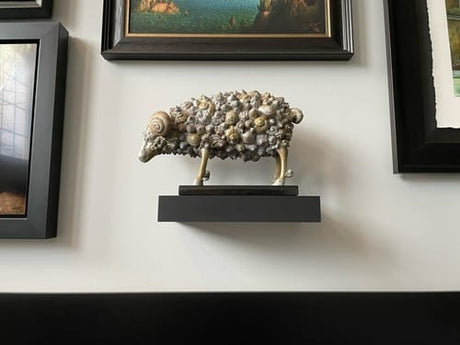

Gallery walls look great in the magazine photo you saved to your phone three years ago. In practice, they require a tape measure, a level, a pencil, seventeen nail holes, a partner who "helps" by telling you it's crooked, and the quiet acceptance that you're never moving any of it. Want to swap in a new print? That's a nail hole to patch, a touch-up paint job, and the slow realization that the new frame is a half inch taller and now the whole grid is off.
A floating shelf above sofa solves all of it. The shelf goes up once, into studs, and then you just lean frames against the wall and rearrange whenever you feel like it. Swap them seasonally. Layer them front to back. Add a small plant between two frames because every shelf looks better with a plant on it. No new holes, no commitment, no drywall repair.
Here's how to set it up right.
The Right Size for a Picture Ledge
Most picture frames are thin. A 5x7 frame is about 3/4" deep. An 8x10 is around an inch. So you don't need a deep shelf to hold them, you just need enough surface for the frame to sit on and lean back at a slight angle.
6" deep is the sweet spot for a dedicated picture ledge. The frame sits on the surface with room to spare, and the shelf stays tight to the wall without projecting far enough to bump into on the way past. This is the depth I recommend for hallways, entryways, and bedrooms where the shelf is purely for display.
8" deep if you want to mix frames with other objects: a small plant, a candle, a stack of two or three books acting as a riser for a smaller frame behind a larger one. The extra 2" gives you room to layer without everything looking crammed together.
For length, match the wall. A long floating shelf at 48" to 60" above a couch handles three to five frames comfortably. A 24" to 36" shelf in a hallway or bedroom holds two or three. Every shelf I build is built to fit your wall at any length from 12" to 72", so you're not stuck rounding to the nearest IKEA increment.
Where Picture Shelves Actually Make Sense
Above the Sofa
The most common spot, and the one where a picture shelf makes the strongest case against a gallery wall. Go 48" to 72" long (roughly two-thirds the width of the couch), mounted 8" to 10" above the back cushions. One shelf, five frames, done. Check the shelf spacing guide if you want to stack two or three shelves vertically, but a single long shelf above a couch is the easiest win in the house.
Above the Bed
Floating shelves above bed replace that one oversized piece of art that came with the frame and never really felt like you. Two or three smaller frames leaned on a 36" to 48" shelf feels personal in a way that a single centered print doesn't. Mount it 8" to 10" above the headboard. If you don't have a headboard, 48" to 54" from the mattress top.
Entryway
A single entryway floating shelf by the front door, 24" to 36" long, holding a framed family photo and a small catch-all tray. It takes up almost no space and it's the first thing someone sees walking in. A wedding photo, a vacation shot, a kid's school picture. Whatever says "people live here and they like each other."
For setups with hooks and daily-use storage, the entryway guide goes beyond display into full organization.
Nursery
Nursery floating shelves with board books displayed covers-out double as picture shelves when the kid's too young to care about books. Framed birth announcement, a few small prints, maybe a photo of the grandparents who are going to spoil them. Mount at 48" to 54" from the floor (adult eye level) for the display phase. Move them down to 24" to 30" when the kid starts grabbing for books.
For a deeper dive on nursery shelf setup by age, the full nursery guide covers everything from board books to big-kid rooms.
Home Office
Above the desk, office wall shelves can hold reference books on one end and two or three personal photos on the other. It breaks up the work-only feeling without turning the office into a shrine. One shelf, 36" to 48" long, 8" deep. Enough room for a photo, a plant, and the illusion that your work-life balance is intact.
How to Keep Frames From Sliding
On a 6" or 8" deep shelf, most frames just lean against the wall and stay put. The back of the frame sits on the shelf surface, the frame tilts back at a slight angle, and gravity handles the rest. It's less precarious than it sounds.
For extra security (earthquake country, cats who think shelves are obstacle courses, or that one door in the house that shakes the whole wall when it closes), a small strip of museum putty on the bottom edge of the frame locks it in place without damaging anything.
There's also a more permanent option. I can route a shallow groove into the front of the shelf surface for $50 per shelf. The groove catches the bottom edge of the frame and keeps it from sliding forward at all. Same customization that works as a plate groove in the kitchen, just applied to picture frames instead. If you're building a picture ledge that's going to hold heavier frames or sit in a high-traffic hallway where things get bumped, the groove is worth it.
Which Finish for a Picture Shelf
The shelf is the background. The frames are the foreground. So the finish question is really about what makes the frames look best.
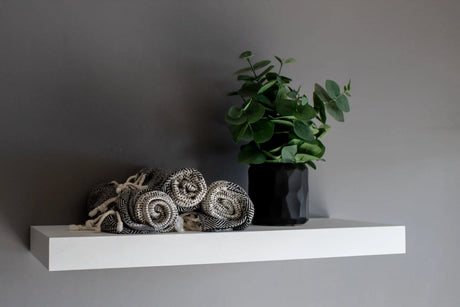
Dark frames (black metal, dark wood, espresso) pop against white floating shelves. The contrast is immediate and the shelf disappears just enough to let the photos do the work.
Light frames (white, natural wood, gold or brass) need a darker shelf to ground them. Cherry gives you a warm reddish tone that deepens over time and looks particularly good with gold or brass frames. Black wall shelves create a bold contrast that works in modern spaces.
Mixed frames (because let's be honest, most of us didn't plan a cohesive frame collection) work best on a neutral wood. Maple is light without being white, so it plays well with pretty much anything. It's the "I don't want to think about it" option, and that's not an insult.
Live Edge: When the Shelf Is Part of the Display
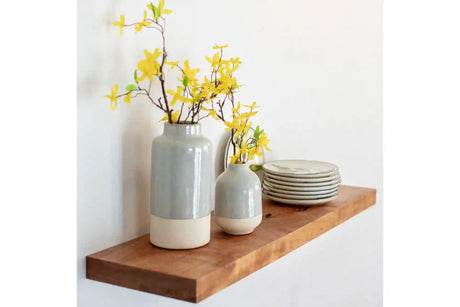
Most picture ledge setups are about the shelf staying invisible. A live edge shelf does the opposite. The natural bark edge running along the front makes the shelf itself a visual element, and the photos on it feel less like a grid and more like objects arranged on a piece of nature.
It's not for every room. A live edge picture shelf in a minimalist white hallway would look out of place. But in a living room with warm tones, a reading nook, or a cabin-style space, live edge adds texture that a straight-edged shelf can't. And because every slab has a different edge profile, no two shelves look the same.
Mounting Height
The standard rule is eye level: 57" to 60" from the floor to the center of whatever's displayed. That works for a standalone shelf on an empty wall.
Above furniture, ignore that number and measure from the furniture instead. 8" to 10" above the sofa back, the headboard, or the desk surface. The shelf should feel connected to what's below it, not floating in no-man's-land halfway up the wall.
In a nursery or kids' room at the display-for-adults phase, mount at adult eye level (48" to 54"). When it converts to a kid's book shelf, drop it to 24" to 30".
The Weight Question (Not Really a Question)
Picture frames are light. A typical 8x10 frame weighs about a pound. A 16x20 frame with glass might hit three pounds. You could line up twenty framed photos on a single shelf and the Hovr bracket system wouldn't notice. It's rated at 150 lbs per stud, so weight capacity is genuinely the last thing to worry about on a picture ledge setup.
Where weight matters more is if you're mixing frames with books, pottery, or heavier decorative objects. Even then, you'd have to try pretty hard to overload a shelf that's rated for 300 lbs on two studs.
Set Up Your Picture Shelf
The gallery wall had a good run. Seventeen nail holes and a roll of spackle later, you've earned something easier.
Browse the full living room floating shelves collection for the right wood, finish, and size. Every shelf is built to order, ships with the Hovr bracket, and holds more weight than a wall of photos will ever ask it to. If you want the front groove routed in for extra frame security, just add it to your order notes for $50 per shelf.