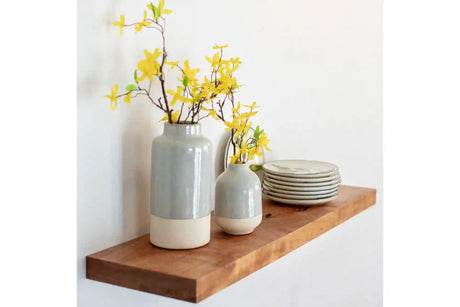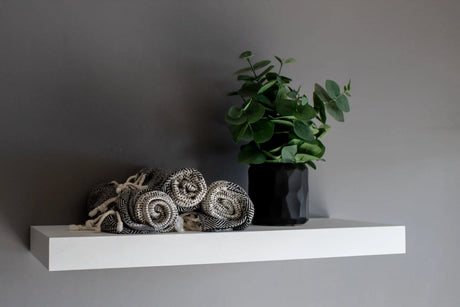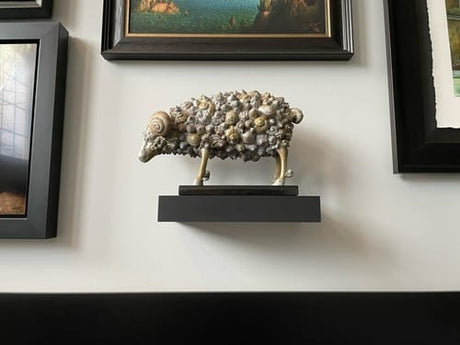

Every house has them: the awkward little walls. The strip between two doorways. The dead space above a toilet. The narrow stretch beside a window. They're too small for art, too narrow for furniture, and so they just sit there empty, mocking you. Until you put a shelf on them.

The trick to making a small wall work isn't finding the perfect shelf. It's understanding what a small wall is actually good at, then sizing accordingly. Most of the styling rules you see online assume you have a big blank wall to fill. Small walls play a different game. Here are 12 ideas for spaces that don't have much to work with, and the practical advice that makes each one not just look right, but actually hold up. If you're shopping for small floating shelves, this is the use-case rundown.
1. The Narrow Strip Above a Toilet
This is the most underused wall real estate in the average house. A single 18" to 24" shelf at 6" to 7" deep, mounted 12" above the tank, holds a candle, a small plant, a folded hand towel, and maybe a framed print. Suddenly the most boring corner of the bathroom is doing visual work.

The practical tip: keep depth under 8" in a bathroom unless the shelf is much higher than reaching distance. A 10" deep shelf above a toilet looks great in photos and feels awful in person because you bang your head on it. Browse bathroom floating shelves for what works in the room overall.
2. The Awkward Space Between Two Doorways
Most homes have at least one of these: a 24" to 36" wall sandwiched between two doorways or between a doorway and a corner. Too narrow for a piece of furniture, too oddly proportioned to feel right with just a piece of art. One small shelf at eye level with two or three intentional objects fixes it instantly.
The practical tip: center the shelf on the wall, not on yourself. The visual centerline of the wall and the centerline of your face are usually 4" to 6" apart, and the shelf needs to sit on the wall's centerline to look balanced from across the room.
3. The Half-Wall Beside a Window in a Bedroom
Bedroom windows almost always leave an awkward 12" to 24" strip of wall next to them. Too narrow for a dresser, too small for art that looks intentional. A single small shelf running vertical-adjacent to the window adds function (alarm clock, glass of water, book) without crowding the bed.
The practical tip: at this size you probably can't hit two studs. The Hovr Bracket System is rated at 150 lbs per stud, so a one-stud install caps you at 150 lbs, which is still more than what a bedside shelf needs to hold. A toggle bolt on the off-stud side adds stability. Worth seeing what fits in the room overall in the bedroom floating shelves collection.
4. The Wall Behind a Desk in a Studio Apartment
Studios and small home offices share the same problem: the wall behind the desk is prime real estate, but most of it is hidden by the monitor. A single 30" to 36" shelf above the monitor, at 6" or 7" depth, gives you a place for the things you reach for without crowding the work surface.
The practical tip: mount the shelf at least 12" above the top of the monitor. Lower than that and you'll clip your hands reaching behind the screen for cables. Higher than 18" and the shelf becomes a place where things go to be forgotten.
5. The Strip Beside a Kitchen Window
Kitchens almost always have a strip of wall next to a window that ends up empty. Too small for cabinetry, too useful to waste. One short shelf at 6" to 8" depth holds a small herb pot, a few measuring cups, or a row of small ceramic jars. The window throws good light on the shelf, which makes whatever sits on it look better than the same items would anywhere else in the kitchen.

The practical tip: white oak or maple holds up best in kitchens because the lighter wood handles kitchen splash and steam better than darker species without showing every water mark. Walnut works too, but be honest with yourself about how often you wipe things down.
6. The Dead Space Above a Low Dresser
A dresser leaves 24" to 36" of wall above it before the ceiling, which is too tall for art alone and too short for two stacked shelves. One small shelf, 24" to 36" long and 8" deep, mounted 10" to 12" above the dresser, creates a tier of usable surface without crowding the dresser top.
The practical tip: match the shelf species to the dresser only if you actually want a matched look. Contrast often reads more intentional than match. A walnut shelf above an oak dresser looks more designed than two walnut pieces stacked.
7. The Narrow Nook by the Front Door
Most entryways have one cramped wall that ends up holding hooks and not much else. Adding a 24" to 30" shelf above the hooks creates a second functional layer: keys, sunglasses, mail, the dog leash that's not currently in use. Suddenly the front door feels organized instead of just functional.
The practical tip: 6" depth is the right call here. Deeper than that and the shelf cuts into the doorway visually. Shallower and you can't actually set anything substantial on it.
8. The Wall Behind a Bedside Table (Where the Table Used to Be)
Skip the nightstand entirely. A single 18" to 24" shelf at 8" depth, mounted 26" to 28" above the mattress, holds a lamp, a book, and a glass of water without taking up floor space. In a small bedroom this opens up 4 to 6 square feet of floor that was previously dedicated to a piece of furniture.
The practical tip: mount the shelf within reach from the pillow. The standard mistake is mounting it too high to actually use lying down. Measure from where your head sits on the pillow, then add 12" to 16" for clearance. That's your shelf height.

9. The Corner Spot That's Too Small for a Real Corner Shelf
Some corners are tight enough that a proper corner shelf would feel like overkill, but two short shelves butted together solve the problem. A 12" shelf on each wall, meeting in the corner, creates a wraparound surface without the bulk. The Hovr Bracket System lets the shelves slide for a tight butt joint, so the corner reads clean instead of pieced together.
The practical tip: if you're going this route, browse the corner floating shelves collection to see how the corner install actually works. Mitered corners look nice in renderings and almost never line up perfectly in real walls, which is why I do butt joints.
10. The Thin Hallway Wall That Catches Light
Hallways usually get treated as transit space and styled accordingly, which is to say not at all. But if the hallway gets any natural light from a window or skylight, a single small shelf at the right height becomes a small moment of intention in a space that otherwise serves no purpose.
The practical tip: keep depth at 6" max in a hallway. Anything deeper than that catches shoulders and elbows as people walk past, which means it ends up scratched within a month. 6" deep at eye level is the sweet spot.
11. The Space Above a Small Couch or Chair
Small living rooms often have a loveseat or armchair against a wall with nothing above it. A single 36" to 48" shelf, centered above the seat at about 10" to 12" above the back cushion, gives the seat visual weight without dropping art or a heavy frame above someone's head.
The practical tip: this is one of the only "small wall" scenarios where you can go up to 48". The shelf needs to roughly match the width of the furniture below it, and a loveseat or chair is wide enough to justify the longer shelf.
12. The Half-Wall in a Small Home Office or Studio
Lots of home offices end up tucked into a corner of a larger room, and the half-wall behind the desk is the most visible piece of real estate when you're on a video call. One shelf, styled with intention, makes the background look intentional instead of accidental.
The practical tip: think about what's behind you on camera, not what looks good in person. A 30" shelf at chest height, two or three objects, no clutter. The camera flattens everything, so simpler reads better than fuller. The Hovr Bracket System keeps the mount invisible from any angle, which matters more on a video call than anywhere else.
The Common Thread Across All 12 Ideas
A few things you'll notice repeating across this list:
- Depth matters more than length on small walls. A 6" or 7" deep shelf reads as intentional. A 10" or 12" deep shelf on a small wall reads as a project that ran out of budget.
- One shelf usually beats two. Stacking two short shelves vertically in a tight space feels cluttered. One well-placed shelf does the work of two without the visual noise.
- Stud placement is real. At 12" to 18" shelf lengths you often can only hit one stud. That's fine. A toggle bolt on the off-stud side gives meaningful support, and 150 lbs per stud is still wildly more than what a small shelf typically holds.
- Custom sizing exists for a reason. Standard shelf sizes are sized for standard walls. If you have a 14" alcove or a 22" stretch between doorways, ordering a shelf made to the exact dimension reads better than forcing a 16" or 24" shelf to almost fit.
The Shelf Expression Approach to Small Walls
Every shelf I build is solid hardwood, made to your exact dimensions, and mounted with the Hovr Bracket System. Standard sizes run from 6" deep and 12" long up to 12" deep and 72" long, in 2" length increments and 1" depth increments.
For walls that need something smaller than the standard minimums, email me. I've made 4" deep shelves for window ledges, 8" long shelves for tight corners, and oddly proportioned shelves for custom built-ins that no manufacturer offers as a stock option. Small shops can build small things. That's part of why this business exists.
If you've been staring at an awkward wall and thinking "nothing's going to work there," I'd argue something will. It just has to be the right size.
When you're ready to fill that wall that's been mocking you for years, browse the small floating shelves collection. Solid hardwood, custom sized, lifetime guarantee. Sized for the wall you actually have, not the wall you wish you had.