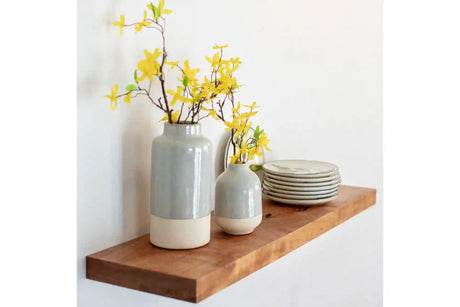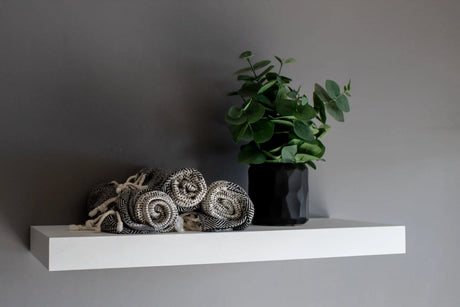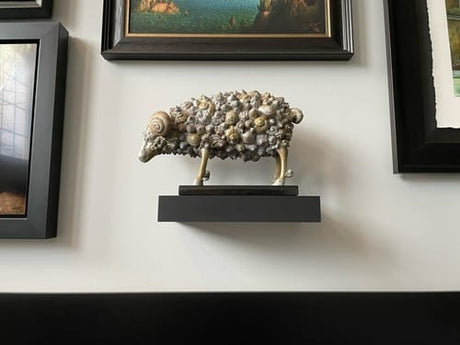

Let's just say it: size matters. Not in a compensating-for-something way, but in a your-shelf-looks-awkward-and-you-know-it way. A shelf that's too short for the wall leaves dead space on either side and makes the whole thing feel like an afterthought. A shelf that's too long crowds the room and competes with everything around it.
Getting length right is one of the most impactful decisions you'll make before ordering, and it's also one of the easiest to get wrong. If you're shopping for long floating shelves, here's everything you need to know before you pull the trigger.
First, Let's Clear Up the Terminology
Shelf sizing language is all over the place depending on who you're buying from. Some suppliers list "width" as the horizontal measurement along the wall. I call that length. What I call depth, which is always the front-to-back measurement, some suppliers call width too. It's a mess.
Here's how I define it, and how all measurements on my site work:
- Length: the horizontal span of the shelf along the wall
- Depth: the front-to-back measurement, from wall to shelf edge
- Height/thickness: how tall the shelf is on its face
When you're ordering from me, length is always the number that tells you how far the shelf runs across your wall. Depth is always front to back. If you keep those two straight, you won't end up with a 12" shelf where you wanted a 12"-deep one.
How to Measure for Shelf Length
Start with the wall space you're working with. Measure the total width of the area where the shelf will live, then decide how much of that space you actually want to fill.
A shelf that runs edge to edge on a wall can look intentional and bold. A shelf that floats in the middle of a large wall with several feet of empty space on either side usually looks like it got lost. The sweet spot for most installations is a shelf that covers roughly 60-80% of the available wall width, though there's no hard rule here. Room scale, ceiling height, and what's flanking the wall all play a role.
If you're hanging a shelf between two fixed points, like between two windows, between a door frame and a corner, inside an alcove, or spanning two cabinets, there's an extra step most people skip: measure both the front of the span and the back. Nothing in a house is perfectly square, and those two numbers are almost never identical. If you order to the front measurement and the back is tighter, you've got a shelf that won't seat properly.

Once you have both measurements, use the smaller of the two and subtract 1/8". That leaves roughly 1/16" of clearance on each side, which sounds like nothing but makes installation dramatically easier. A shelf cut exactly to the span will fight you every step of the way. A shelf cut 1/8" short slides right in. Nobody will ever notice a 1/16" gap at each end, but you'll definitely notice if you're trying to muscle an exact-fit shelf into a slightly out-of-square opening.
Does Going Longer Actually Look Better?
Usually, yes. Longer shelves tend to look more architectural and intentional. A 60" shelf on a wall that can handle 72" will look substantial. A 36" shelf on that same wall will look like you ran out of ideas halfway through.
That said, longer shelves also hold more visual weight. If the shelf is going in a smaller room or above a piece of furniture with a defined width (a sofa, a dresser, a console table), matching the shelf length roughly to the furniture beneath it creates a more cohesive look than going dramatically wider.
A common and well-proportioned approach: if you're hanging a shelf above a sofa, order a shelf that's within 6"-12" of the sofa's width on each side. Close enough to feel related, with just enough overhang to feel intentional.

When One Shelf Isn't Enough
My maximum shelf length is 72". If your wall runs longer than that and you want continuous coverage, the answer is breaking the run into two or three shelves rather than trying to fake a single long one.
Here's the thing about that: don't try to butt them tight together and pass them off as one shelf. Two shelves jammed together with an uneven seam in the middle looks worse than two shelves with intentional spacing between them. Leave a small gap, somewhere in the 1/4" to 1/2" range, between each shelf in the run. That gap reads as deliberate. Without it, the slight misalignment that's inevitable between two independently installed shelves just looks like a mistake.
Two or three shelves with a consistent small gap looks like a design decision. Two shelves trying to masquerade as one looks like a woodworking error. Lean into the gap.
The Bracket Situation on Long Shelves
For shelves in the longer range, particularly anything from 48" up to 72", I use a 47" bracket. That bracket spans enough wall distance to hit at least three studs, assuming standard 16" on-center stud spacing. Three studs means the Hovr bracket is pulling from three anchor points, which gives you serious holding power well beyond what most people will ever load onto a shelf.
The practical upshot: you don't need to worry about a 72" shelf sagging in the middle. The bracket engineering handles that. What you do need to think about is what you're putting on it. The Hovr bracket system is rated at 300 lbs total capacity, 150 lbs per stud. Three studs at 150 lbs each means the limiting factor on a long shelf is almost certainly going to be common sense before it's the bracket.
If you want to go deeper on load capacity, my post on how much weight a floating shelf can hold breaks it all down.
Depth and Length Work Together
Length gets all the attention, but depth shapes how a shelf reads in a room almost as much. A 72" shelf at 6" deep looks sleek and minimal, almost like a ledge. That same 72" shelf at 12" deep looks substantial and functional, more like a piece of furniture on the wall.
Think about what you're putting on the shelf and match the depth to the use. Books need at least 8"-10". A display shelf with small objects can get away with 6"-8". A kitchen shelf holding plates, oils, and a few plants probably wants 10"-12". I build every shelf custom, so you're not locked into a standard depth. Custom sizing runs from 6" to 12" deep and 12" to 72" long.

For a deeper dive on depth specifically (yes, that's a sentence), the floating shelf depth guide covers exactly this.
Species and Length: What to Consider
Longer shelves show more grain. That's not a problem, it's actually one of the best arguments for going long. A 72" white oak floating shelf with a clean straight grain running the full length of the wall is genuinely beautiful in a way that a shorter shelf just can't replicate.
Grain continuity matters more at longer lengths. On a shorter shelf, grain pattern is almost incidental. On a 60"+ shelf, it becomes part of the design. If you're particular about grain direction and figure, mention it when you order and I'll do my best to pull a board that delivers.
Walnut floating shelves in longer lengths are particularly striking because the rich brown tones and natural grain movement read really well at a distance. Live edge options are also available if you want something with even more character at scale.
A Quick Pre-Order Checklist
Before you finalize your length:
- Measure the full wall width, then decide how much of it you want to fill
- Account for any fixed obstructions (trim, outlets, switches, windows) that affect usable length
- If your run exceeds 72", plan for two or three shelves with a small intentional gap between them
- Consider the furniture or objects beneath the shelf and whether you want the shelf to roughly match, slightly overhang, or dramatically contrast in width
- Match depth to what you're storing, not just what looks good in a photo
If you're still not sure what length to order, reach out. Send me the wall dimensions and a photo if you have one, and I'll give you a recommendation.
Whether you're after a single statement shelf or a full wall run, browse the extra long floating shelves collection to see what's available. Custom lengths up to 72", seven species, made to order in Charlotte, NC.