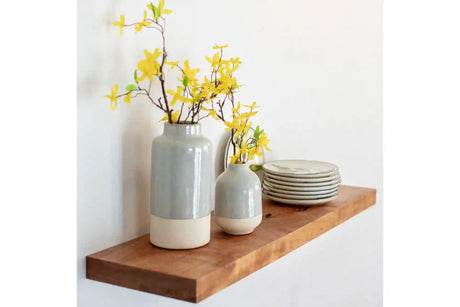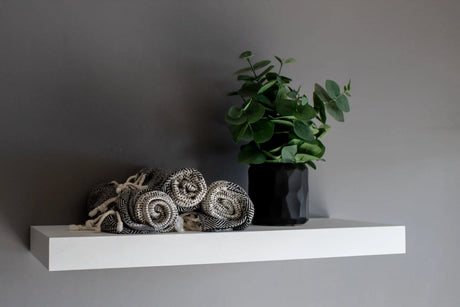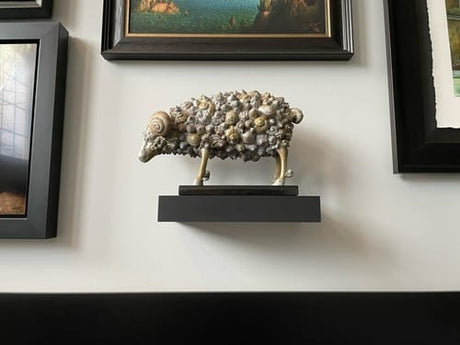

Yes, I'm a floating shelf company, and yes, I'm about to tell you why floating shelves might not be the best fit for you. Sounds backwards. But I'd rather you love your solid wood floating shelves for the next 20 years than regret buying them after six months.
Floating shelves are what I've built my entire business around, and I think they're great. But they're not flawless, and pretending otherwise doesn't help anyone. Here are the real advantages, the real disadvantages, and my honest take on when they make sense and when they don't.
The Advantages
Clean, minimal look. No chunky brackets, no cabinet boxes. Just solid hardwood and whatever you choose to display. They work in just about any style of home, from modern to farmhouse, and they always look intentional.

They make spaces feel bigger. Cabinets eat up visual space. Shelves don't. If you're working with a small kitchen or a tight bathroom, floating shelves open things up and keep everything feeling light. Kitchen floating shelves especially make a room feel larger by keeping sightlines open and showing more wall surface.
Custom sized to fit your space. Every shelf I build is built to fit your wall, so you're not stuck choosing from three sizes at a big box store. Length, depth, wood species, finish, edge profile, even LED channel routing. If you can describe it, I can probably build it.

Stronger than they look. Not all floating shelves are flimsy. With the Hovr bracket, which holds 150 lbs per stud, these shelves handle real weight: dishes, books, cast iron, a full liquor collection. The full weight capacity breakdown covers the numbers in detail.
The Disadvantages
Limited storage compared to cabinets. Shelves don't have doors. If you need to hide mismatched Tupperware, a junk drawer's worth of takeout menus, or the evidence that you haven't organized your spice rack since 2019, cabinets are the better call. Floating shelves are about display, not concealment.
This is the single biggest reason people choose cabinets over open shelving, and it's a valid one. If maximum hidden storage is the priority, floating shelves aren't the answer. No amount of beautiful hardwood changes that.
Dust and kitchen grease. Open shelves collect dust faster than cabinets. That's just physics. And if they're near a stove or cooktop, cooking oils aerosolize and settle on everything: the wood, the dishes, the decorative plant that was supposed to make the kitchen feel alive.

The closer your shelves are to the action, the more often you'll wipe them down. Some ways to minimize the maintenance: keep cooking-area shelves higher up or offset from the stove, stick to items that rinse easily (glassware, ceramics), and make a quick wipe part of your normal kitchen routine. My cleaning guide covers this in more detail.
For bathrooms, steam and humidity are the equivalent concern. Bathroom floating shelves ship with a polyurethane seal that handles moisture, but you'll still want to wipe them down after heavy steam.
Installation takes some care. These aren't the kind of shelves you throw up with two drywall anchors and call it a day. The wall needs to be reasonably flat, the studs need to be in the right place, and the bracket needs to be level. A bowed wall is fixable with shims, but it adds a step. I wrote about why most shelves sag and most of the time it comes down to installation shortcuts.
That said, the actual install takes about 10 minutes per shelf if your studs cooperate. Level, drill, mount the bracket, slide the shelf on. It's not a renovation project.

Weight limits with cheap brackets. This is the disadvantage that gets blamed on floating shelves when it's really a bracket problem. Most budget shelves use a two-prong rod system that tops out at 30 to 50 lbs. Put dinner plates or cookbooks on them and they sag within months.
The Hovr bracket solves this (150 lbs per stud), but if you're buying generic shelves from a big box store, weight limits are a real concern. Heavy duty wall shelves with proper bracket hardware exist specifically because standard hardware can't handle real-world use.

Not everyone likes open shelving. Some people want maximum storage and zero visual clutter. Some people don't want to see their dishes every day. Some people just prefer the look of cabinet doors. That's not wrong. Floating shelves lean toward the modern, minimal side of design, and if that's not your style, cabinets are probably the better fit. No judgment.
My Honest Take
I built a business around floating shelves because I think they're the better choice for most rooms in most homes. But "most" isn't "all."
Floating shelves make sense if you want open, airy style over maximum hidden storage. If you're okay with regular dusting (and occasional wiping near the stove). If you've got solid walls and studs in the right place. If you like seeing your favorite things on display rather than behind a door.
They don't make sense if you need to hide everything, if you hate dusting, or if your walls are concrete and you're not willing to drill into them.
If you're leaning toward shelves, the quality of what you buy matters more than anything else. Solid hardwood doesn't flex, warp, or sag the way MDF does. White oak and walnut both hold up in kitchens and bathrooms where moisture and heat are factors. The Shelf Expression Promise includes a lifetime guarantee against warping and cracking, because I don't sell shelves I'm not willing to stand behind.
Browse living room shelves, kitchen floating shelves, or bathroom floating shelves to see what's available. And if you're still on the fence, that's fine too. Cabinets aren't going anywhere.